Codetown
Codetown ::: a software developer's community
Tuesday, October 23, 2012
-
AITP October Dinner Presentation
October 23, 2012 from 5:30pm to 8:30pm – UF Hilton Something a little lighter going into the holidays: In this fascinating slide-illustrated presentation, Dr. Andrew Nichols discusses his research into the causative effects of geomagnetic activity in… Organized by AITP North-Central Florida Chapter | Type: presentation, and, dinner
Happy 10th year, JCertif!
Notes
Welcome to Codetown!
 Codetown is a social network. It's got blogs, forums, groups, personal pages and more! You might think of Codetown as a funky camper van with lots of compartments for your stuff and a great multimedia system, too! Best of all, Codetown has room for all of your friends.
Created by Michael Levin Dec 18, 2008 at 6:56pm. Last updated by Michael Levin May 4, 2018.
Looking for Jobs or Staff?
Check out the Codetown Jobs group.
InfoQ Reading List
OpenJDK News Roundup: Vector API, Compact Object Headers and G1GC as Default in JDK 27

There was a flurry of activity in the OpenJDK ecosystem during the week of May 18th, 2026, highlighting three JEPs elevated from Proposed to Target to Targeted and three JEPs elevated from Candidate to Proposed to Target for JDK 27. The proposed release schedule has also been finalized.
By Michael RedlichGoogle Introduces Middleware Architecture for Genkit Applications
Google has introduced Middleware for Genkit, its open-source framework for building AI-powered and agentic applications. The update adds a programmable interception layer around model calls, tool execution, and generation loops, giving developers more control over reliability, safety, and orchestration inside production AI systems.
By Robert KrzaczyńskiAWS MCP Server Reaches GA with Full API Coverage and IAM-Based Governance

AWS has recently made its managed Model Context Protocol (MCP) server generally available, giving AI coding agents controlled access to AWS APIs, documentation, and operational workflows through a standard interface. It provides a safer and more auditable way to connect AI agents to AWS services without handing over broad credentials.
By Renato LosioGoogle Cloud Introduces Cross-Engine Iceberg Support in BigQuery

At the Apache Iceberg Summit last month, Google announced new interoperability features for Apache Iceberg in BigQuery. The preview of the serverless Iceberg REST catalog lets teams create, update, and query the same Apache Iceberg tables in BigQuery and in engines like Spark, Flink, and Trino without duplicating data.
By Renato LosioUber Improves Restaurant Recommendations Using Real-Time Signals and Listwise Ranking
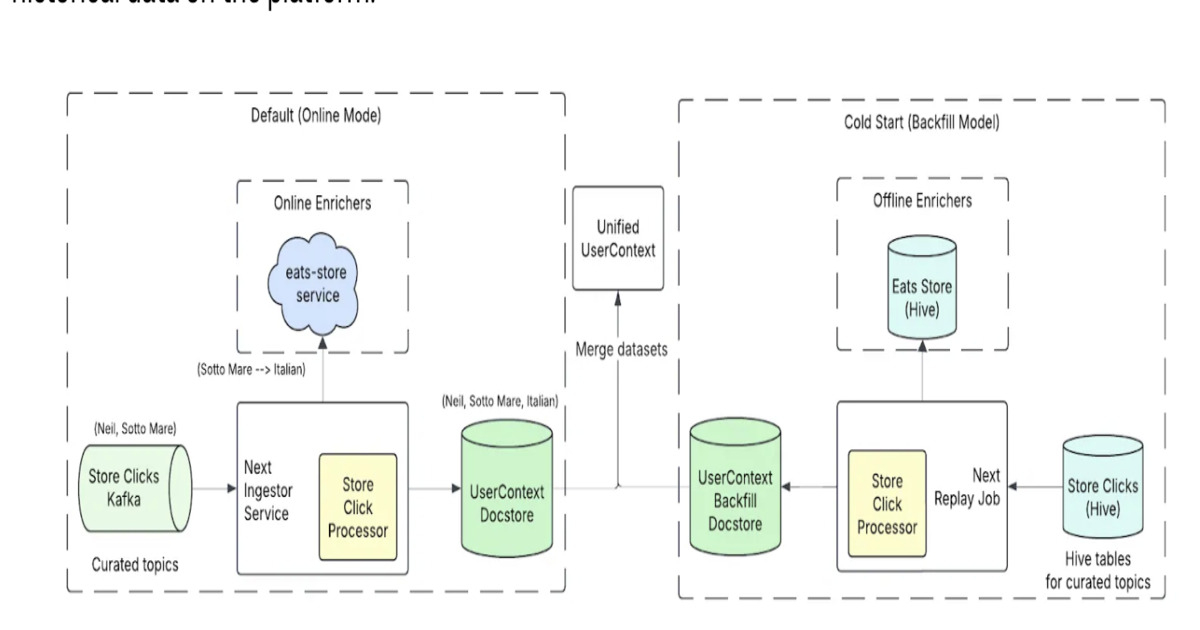
Uber updates its Uber Eats Home Feed recommendation system using near real-time user sequence features and a Generative Recommender model. The system evolves from hand-crafted features to transformer-based sequence modeling, reduces feature freshness from 24 hours to seconds, and shifts from pointwise scoring to listwise GenRec for improved contextual ranking and real-time personalization.
By Leela Kumili
© 2026 Created by Michael Levin.
Powered by

