Codetown
Codetown ::: a software developer's community
Jim Clarke's Blog – September 2011 Archive (1)
GroovyFX, Getting started.
Dean Iverson and I have been working on an open source project called GroovyFX that provides a Groovy binding that sits on the new JavaFX 2.0 platform. Dean has written a good blog on how to get started with GroovyFX here. It is already a little dated, but if you ignore the JavaFX build numbers and just download the…
ContinueAdded by Jim Clarke on September 27, 2011 at 4:51pm — No Comments
Latest Blog Posts
Most Popular Blog Posts
Happy 10th year, JCertif!
Notes
Welcome to Codetown!
 Codetown is a social network. It's got blogs, forums, groups, personal pages and more! You might think of Codetown as a funky camper van with lots of compartments for your stuff and a great multimedia system, too! Best of all, Codetown has room for all of your friends.
Created by Michael Levin Dec 18, 2008 at 6:56pm. Last updated by Michael Levin May 4, 2018.
Looking for Jobs or Staff?
Check out the Codetown Jobs group.
InfoQ Reading List
Meta Brings Code Review Auto-Approval More Mainstream with PyTorch GreenLight
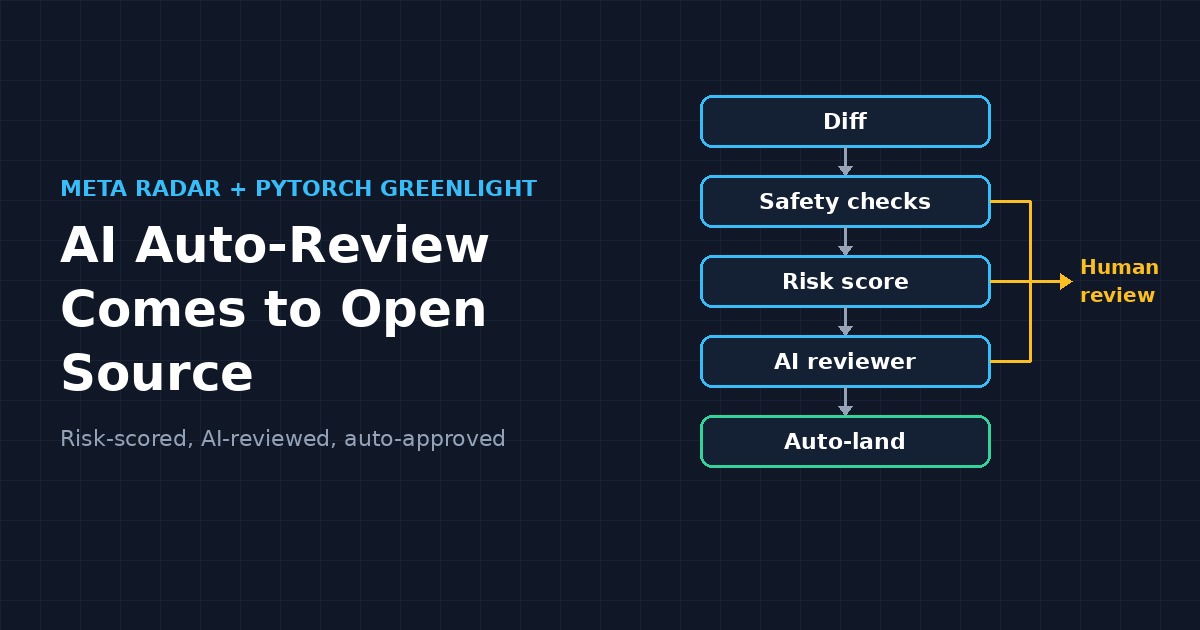
PyTorch now lets an AI reviewer approve pull requests from its own maintainers. GreenLight is an open-source take on RADAR, the system Meta uses to auto-land low-risk diffs after safety checks, a risk score and an LLM review. OpenAI, Anthropic and Sonar describe similar ways to automate approval while keeping humans on risky changes.
By Andrew HoblitzellNetflix Builds Quasar to Measure the Blast Radius of Library API Changes

Netflix developed Quasar, an internal tool that combines semantic code indexing and API comparisons to identify downstream consumers affected by library changes. Using SCIP, Amazon S3, and Athena, it traces API references across repositories, helping maintainers assess migration impact and make informed release decisions. Netflix is also exploring agent-assisted consumer migrations.
By Leela KumiliGrafana Begins Its Biggest UI Refresh Since Version 7
Grafana Labs has introduced the first phase of its biggest visual refresh since Grafana 7, bringing updated themes, more consistent interface components, and improved visual hierarchy to its observability platform.
By Craig RisiPresentation: From Fan-Out to Fast: Sub-100ms API Design in Distributed Systems

Saranya Vedagiri explains how to design resilient, low-latency distributed APIs under 100ms. Drawing on practical scale at eBay, she discusses hop-by-hop latency budgets, async fanout tradeoffs, thread pool sizing, caching, and circuit breakers. Learn actionable strategies to eliminate tail-latency bottlenecks and establish performance-first engineering practices.
By Saranya VedagiriArticle: Engineering Reliable Telematics from Smartphone Sensors

Smartphones make telematics more accessible by combining location, motion sensors, computing power, and connectivity in a single device. But the convenience comes with a trade-off: device placement varies, sampling behavior is managed by the mobile platform, and measurements have different timing and coordinate semantics. This article explores a six-stage architecture to address these challenges.
By Praveen Kumar Gopalakrishnan
© 2026 Created by Michael Levin.
Powered by

