Codetown
Codetown ::: a software developer's community
April 2010 Blog Posts (3)
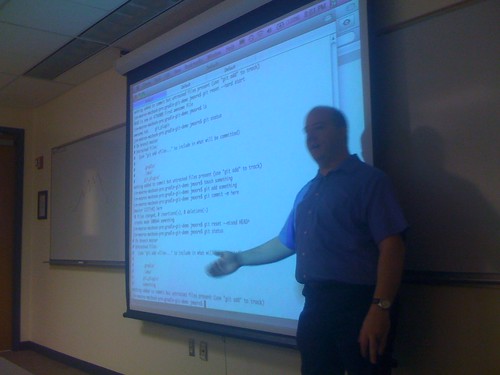
 OrlandoJUG Git Presentation with Jim Moore - April 2010
A Look At Git.pdf
Jim's talk on Git and Gradle was very informative. We finally gave in and said "let's just talk about Git and look at Gradle another time". Git has… Continue
Added by Michael Levin on April 30, 2010 at 8:30am — No Comments
Codeslinger Shootout
The GatorLUG Codeslinger Shootout is tonight! If you cant make it, then stay tined to the GatorLUG website to see who wins and how. http://www.gatorlug.org/node/261
Added by Michael Levin on April 21, 2010 at 4:30pm — No Comments
HTML5, Flash and iPad - Pop Culture ... what do you think?
I think HTML5 has a lot to offer. I think it's pretty bold to say Flash is going to die. I can't wait to play with an iPad. But, you and I know that just around the corner will be an "open pad"! Hmmmm,
openpad dot com - has a catchy ring to it,… Continue
Added by Michael Levin on April 5, 2010 at 4:30pm — No Comments
- ❮ First
- Next ❯
Featured Blog Posts
Latest Blog Posts
Most Popular Blog Posts
Monthly Archives
2026
- July (2)
2025
2024
- June (1)
2023
2022
2021
2020
2019
- December (1)
- November (1)
- October (1)
- September (1)
- August (2)
- July (1)
- June (4)
- May (1)
- March (2)
- February (1)
- January (2)
2018
2017
2016
- December (18)
- November (10)
- September (3)
- August (1)
- July (3)
- June (7)
- May (6)
- April (5)
- March (2)
- February (2)
- January (4)
2015
- December (4)
- November (2)
- October (2)
- August (1)
- July (2)
- June (1)
- April (2)
- March (6)
- February (1)
- January (6)
2014
2013
2012
- December (5)
- October (3)
- September (4)
- August (1)
- July (4)
- June (4)
- May (1)
- April (3)
- March (4)
- February (7)
- January (3)
2011
- December (1)
- November (7)
- October (6)
- September (7)
- August (3)
- July (9)
- June (5)
- May (7)
- April (2)
- March (2)
- February (3)
- January (4)
2010
- December (6)
- November (3)
- October (2)
- August (6)
- July (1)
- May (4)
- April (3)
- March (11)
- February (5)
- January (13)
2009
- December (10)
- November (4)
- October (7)
- September (4)
- August (5)
- July (2)
- June (3)
- May (9)
- April (2)
- March (8)
- February (3)
- January (1)
2008
Happy 10th year, JCertif!
Notes
Welcome to Codetown!
 Codetown is a social network. It's got blogs, forums, groups, personal pages and more! You might think of Codetown as a funky camper van with lots of compartments for your stuff and a great multimedia system, too! Best of all, Codetown has room for all of your friends.
Created by Michael Levin Dec 18, 2008 at 6:56pm. Last updated by Michael Levin May 4, 2018.
Looking for Jobs or Staff?
Check out the Codetown Jobs group.
InfoQ Reading List
Cloudflare K2 Builds Event Streams on R2 Object Storage, at a Second of Produce Latency

Cloudflare has launched K2 in public beta, a serverless event streaming service implementing a durable log on R2 object storage. Cloudflare states produce latency of about one second at p99; a tester reported end-to-end p99 of 7.5 seconds, which a commenter answering for the team said was higher than expected. Consume charges match produce charges per GB.
By Steef-Jan WiggersPresentation: Multi-Agent Patterns from Spotify’s AI Powered Advertising Platform

Pratik Rasam discusses how Spotify Ads Manager runs production-grade multi-agent systems at scale using Google ADK Java. He shares key architectural patterns, domain ownership models, deterministic guardrails, and tracing-based evaluation strategies, detailing hard-learned lessons on drawing agent boundaries, optimizing tool schemas, and managing costs while avoiding monolithic agent pitfalls.
By Pratik RasamTechnological Sovereignty Requires Choice, Skills, and Support, Panelists Say During OSS EU

European organisations can enhance their technological sovereignty by developing credible alternatives and acquiring necessary skills, rather than completely avoiding global providers. A panel discussion at the OSS EU highlighted the importance of understanding dependencies in cloud and hardware, and emphasized the need for practical choices in software for effective operational sovereignty.
By Olimpiu PopCloudflare Open Sources Decision Models for AI Agents

During its recent “Birthday Week”, Cloudflare announced Clef, a set of open-weight AI models designed to choose between predefined options rather than generate text. Cloudflare released 9B- and 27B-parameter models, along with a platform for adapting them to specific decision-making tasks.
By Renato LosioSurvey Finds AI-Generated Code Increases Debugging and Failure Rates and Creates a Comprehension Gap

A survey conducted by independent research firm Coleman Parkes on behalf of Undo, a company focused on scaling AI-powered root-cause analysis, found that while AI coding agents have accelerated code generation, they have shifted the primary bottleneck to debugging, code comprehension, and maintenance.
By Sergio De Simone
© 2026 Created by Michael Levin.
Powered by

