Codetown
Codetown ::: a software developer's community
Cloud Computing Village
Information
Cloud Computing is "the next big thing". The recent JavaOne featured Cloud Computing more than any other technology. Come join us and explore / discuss the aspects of this technology!
Members: 16
Latest Activity: Aug 21, 2015
About The Cloud Computing Village
(image from Wikipedia)
Cloud Computing is an enabling technology that essentially relies on distributed data stores and networks to allow data storage across distributed containers. There are many pros and cons to consider, a world of approaches and uses to discuss. We'll talk about them here in the Cloud Computing Village. Join us!
Discussion Forum
What's the difference between Grid computing and Cloud Computing 5 Replies
I don't clearly catch the difference betwenn these two concept. Someone told me that the essential différence is that the cloud computing give you a large space of storage and the grig give more…Continue
Started by Hervé-greg MOKWABO. Last reply by Hervé-greg MOKWABO Nov 29, 2011.
Searching for Cloud architecture
After reviewing architecture models from several vendors and industry organizations, I believe we are witnessing an early evolutionary period, rather than the culmination of PaaS. The lack of…Continue
Tags: architecture, Cloud, PaaS
Started by Chris Haddad Nov 25, 2011.
Shameless Plug: New Application 1 Reply
Hey everyone,Don't know if you remember me but I did the Android class last year. Anyway I just published my first app. It is a pay app but that is to support development :-). Anyway look up Motion…Continue
Tags: Android
Started by Jackie Gleason. Last reply by Michael Levin Oct 25, 2011.
Cloud Computing Reading List
 Loading feed
Comment Wall
Comment
-
Comment by Chris Haddad on November 18, 2011 at 9:50am
-
Orlando Workshop on December 15, 2011
Title: understanding cloud-enabled modular middleware
WSO2 Carbon and Stratos provides a complete middleware platform for Enterprise computing: from on-premise to a full cloud-enabled runtime. In this session we will spend the morning looking at the Carbon platform – including leading ESB, AppServer, Governance Registry and more. In the afternoon we will look at the way this runtime is also available in a multi-tenant scalable, elastic architecture. This session will cover SOA and Cloud middleware, PaaS as well as digging deep into Cloud concepts.
This hands-on workshop provides a real opportunity to understand Carbon, OSGi middleware, PaaS, Stratos, and get going with a Cloud Platform. StratosLive is a complete running platform in the cloud, and participants will be encouraged to set up a tenant using their laptops during the workshop, and will understand how to install and use Stratos in a Private PaaS environment.
Location: Orlando, FL
Date: December 15, 2011
Registration page: http://wso2.com/events/workshops/2011-december-orlando-carbon-and-s...
-
-
Thanks, Michael for the welcome note. I look forward to learning more about this new challenging technology.
-
Comment by Michael Levin on October 27, 2011 at 10:55pm
-
Hi Efren and welcome to the group. We had some great discussions about ClouD Computing tonight at the OrlandoJUG meeting. Stay tuned - I hope the lads post some notes... All the best, Mike
-
Comment by Thomas O'Hare on October 26, 2011 at 7:56am
-
Michael
Look forward to checking out the newest old technology! ;-)
Thanks,
Thomas
-
Comment by Blaine Buxton on October 25, 2011 at 10:42pm
-
Hello Micheal. I look forward to the discussions.
-
-
Hi Blaine! I just downloaded iOS5, so I guess I am cloud computing! Welcome to the group! /m
-
-
Howdy, Jackie! Thanks for dropping by, Check out the Issues discussion. There's some food for thought... Best, Mike
-
-
Hey, Thomas! Thanks for joining the Cloud Computing Village. Looking forward to learning together... Best, Mike (enjoying Florida sunshine!)
Happy 10th year, JCertif!
Notes
Welcome to Codetown!
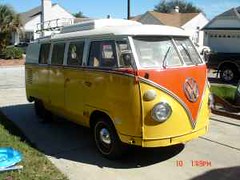 Codetown is a social network. It's got blogs, forums, groups, personal pages and more! You might think of Codetown as a funky camper van with lots of compartments for your stuff and a great multimedia system, too! Best of all, Codetown has room for all of your friends.
Created by Michael Levin Dec 18, 2008 at 6:56pm. Last updated by Michael Levin May 4, 2018.
Looking for Jobs or Staff?
Check out the Codetown Jobs group.
InfoQ Reading List
AWS Introduces Amazon S3 Annotations

AWS recently announced Amazon S3 Annotations, a feature that lets teams attach rich, searchable context such as summaries, classifications, compliance data, or AI-generated insights directly to S3 objects. Annotations can be updated independently of the object and queried across datasets, reducing the need for separate metadata systems.
By Renato LosioClaude Reaches GA on Microsoft Foundry: European Enterprises Cannot Deploy It

Claude models reached GA on Microsoft Foundry with Azure-native billing and governance, but no European data zone exists. Anthropic's own documentation confirms data residency guarantees apply to Bedrock and Vertex AI but not Foundry. European practitioners from banking and healthcare report the offering is unapproved for production.
By Steef-Jan WiggersCycle Introduces EU Control Plane as Sovereignty Debate Continues

Cycle recently introduced a separate EU-based control plane, allowing European customers to keep platform management data and telemetry within Europe. The new offering is designed to improve compliance, operational isolation, and responsiveness for European organizations.
By Renato LosioCloudflare Details Unified Data Platform Where Billing Workloads Account for 53% of Queries
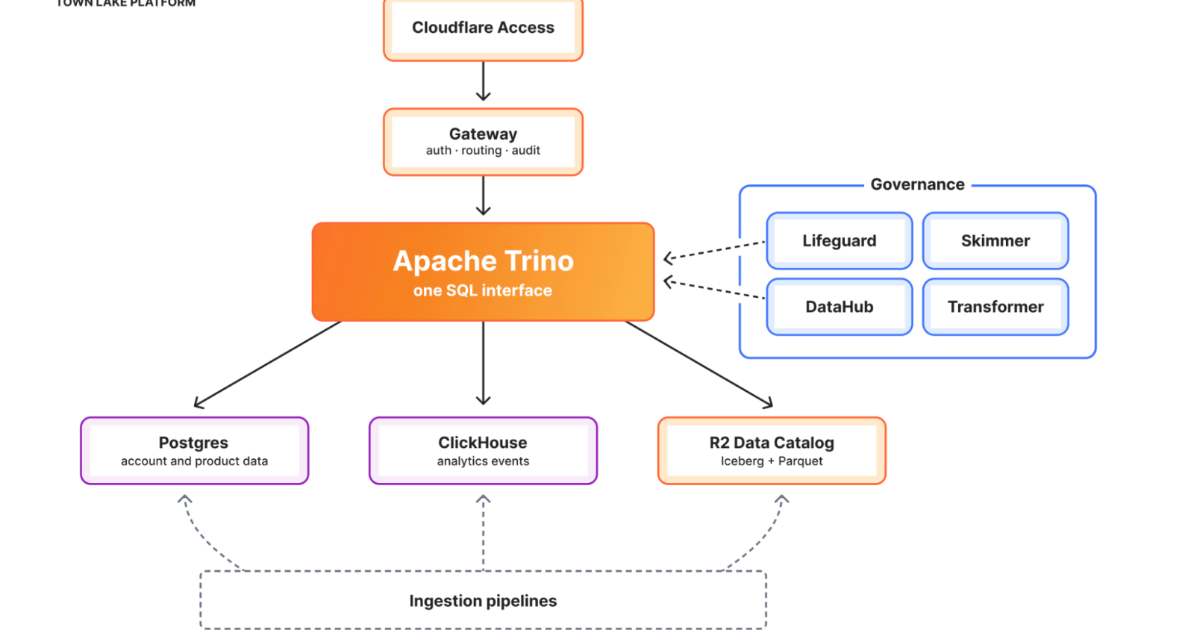
Cloudflare details Town Lake, an internal unified data platform, and Skipper, an AI analytics agent unifying access to operational, billing, security, and business data. The platform processed ~91K billing queries, with billing forming majority usage. Built on a lakehouse architecture using Trino, Iceberg, R2, and DataHub, it enables governed cross-system analytics and natural language access.
By Leela KumiliHardwood Promises High-Speed JVM Apache Parquet Processing with Zero Mandatory Dependencies

Hardwood, the project Gunnar Morling kick-started to improve the handling of Parquet files in Java, reached version 1. Its multi-threaded approach and zero mandatory external dependencies promise a simpler, optimal alternative to the Apache Parquet Java implementation. For now, the library provides a reading via API and a CLI for visualisation; writing support is expected in the upcoming versions.
By Olimpiu Pop
© 2026 Created by Michael Levin.
Powered by


You need to be a member of Cloud Computing Village to add comments!