Codetown
Codetown ::: a software developer's community
Cloud Computing Village Discussions (7)
| Discussions | Replies | Latest Activity |
|---|---|---|
What's the difference between Grid computing and Cloud ComputingI don't clearly catch the difference betwenn these two concept. Someone told me that the essential différence is that the cloud computing g… Started by Hervé-greg MOKWABO |
5 |
Nov 29, 2011 Reply by Hervé-greg MOKWABO |
Searching for Cloud architectureAfter reviewing architecture models from several vendors and industry organizations, I believe we are witnessing an early evolutionary peri… Started by Chris Haddad |
0 | Nov 25, 2011 |
EnsembleEnsemble: service orchestration for the cloud (my work for Ubuntu Server) http://fewbar.com/2011/06/so-what-is-ensemble-anyway - via Jim Ba… Started by Michael Levin |
1 |
Nov 1, 2011 Reply by Michael Levin |
Shameless Plug: New ApplicationHey everyone, Don't know if you remember me but I did the Android class last year. Anyway I just published my first app. It is a pay app b… Started by Jackie Gleason |
1 |
Oct 25, 2011 Reply by Michael Levin |
Issues to Consider with Cloud ComputingThinking about Cloud Computing raises some concerns. Security is one concern that looms in many minds. What are some issues and how can we… Started by Michael Levin |
0 | Oct 25, 2011 |
Advantages of Cloud ComputingAny time we use devices that are detached, remote, or somehow "managed" outside our normal environment, we realize advantages. Some obvious… Started by Michael Levin |
0 | Oct 25, 2011 |
What is Cloud Computing?What is Cloud Computing? Of course, the name Cloud Computing is a metaphor that describes the grouping together of data in a virtual storag… Started by Michael Levin |
0 | Oct 25, 2011 |
Happy 10th year, JCertif!
Notes
Welcome to Codetown!
 Codetown is a social network. It's got blogs, forums, groups, personal pages and more! You might think of Codetown as a funky camper van with lots of compartments for your stuff and a great multimedia system, too! Best of all, Codetown has room for all of your friends.
Created by Michael Levin Dec 18, 2008 at 6:56pm. Last updated by Michael Levin May 4, 2018.
Looking for Jobs or Staff?
Check out the Codetown Jobs group.
InfoQ Reading List
Presentation: Trustworthy Productivity: Securing AI-Accelerated Development
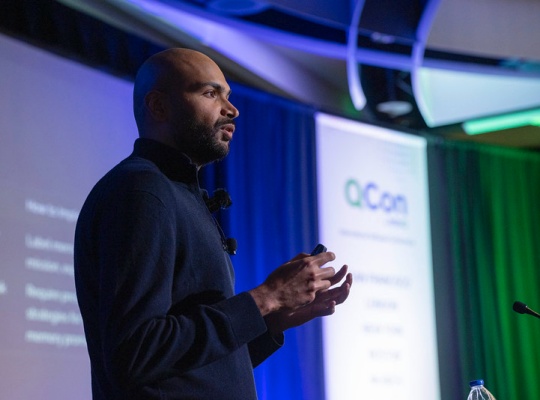
Sriram Madapusi Vasudevan discusses industry-converging patterns for securing autonomous AI agents in production. He explains the critical vulnerabilities hidden inside the ReAct loop across context, reasoning, and tool execution. He shares how to mitigate risks like memory poisoning and rogue tool execution using defense-in-depth strategies, LLM-as-a-judge critics, and MAESTRO threat modeling.
By Sriram Madapusi VasudevanElastic Open-Sources Atlas Agent Memory Based on Cognitive Science

Elastic open-sourced Atlas, a system built on Elasticsearch that maintains three categories of memory for agents. Atlas integrates with agents via MCP and maintains per-user isolation of memories. When evaluated on question-answering capability, it scored 0.89 Recall@10.
By Anthony AlfordMicrosoft Brings AI-Powered Vulnerability Remediation to Azure DevOps with Copilot Autofix

Microsoft has announced the limited public preview of Copilot Autofix for GitHub Advanced Security for Azure DevOps, extending AI-powered vulnerability remediation to teams using Azure Repos.
By Craig RisiAWS Launches Lambda MicroVMs for Isolated Agent and User Code Execution

AWS launched Lambda MicroVMs, a new serverless compute primitive that runs each user session or AI agent in its own Firecracker virtual machine with hardware-level isolation, snapshot-based rapid launch, and state preservation for up to eight hours. Reddit community analysis found the minimum setup costs $3.03/day, roughly 9x Fargate spot pricing.
By Steef-Jan WiggersArticle: Scaling Java-Based Real-Time Systems: The Hidden Tradeoffs of Event-Driven Design

Event-driven architecture promises scalability, but in Java-based real-time systems the tradeoffs only surface in production. Drawing on a Java/Kafka contact center platform handling 80k BHCC across 10k agents, this article details where the design breaks down—state management, partition limits, deduplication, JVM tuning, cascading consumer failures—and the Redis-backed patterns that fixed each.
By Sagar Deepak Joshi
© 2026 Created by Michael Levin.
Powered by

