Codetown
Codetown ::: a software developer's community
Whats the best iPhone development environment?
Views: 131
Replies to This Discussion
-
Permalink Reply by Robert Hedin on
-
If you're wanting to write for the App Store, XCode is pretty much it. All of the iPhone libraries are either Objective-C (user interface) with some C level under pinnings.
As far as books go, to be honest I don't believe anything really talks about the current 3.1 OS, so I'm a bit hesitant to recommend anything today. The Apple docs on the dev site aren't too bad.
rob. -
-
Permalink Reply by Kevin Neelands on
-
Mara said:
Let's just say I've been better.how are you -
-
Permalink Reply by Walt Sellers on
-
If you look at some of the developer agreements, at least one of them specified that the software must be developed on a Mac.
The Mac Mini is the cheapest to buy new, but any Intel-based Mac will do. I recommend against any of the single-core Macs myself.
I've read Zdziarski's "iPhone Forensics" book and it was really good. (Perhaps outdated now.) And its an O'Reilly book. So his other books might also be good.
I've looked through a "cookbook" in the bookstore. It seemed really straight-forward, except that it kept mentioning things that were not in the public API's (Apple's agreements require using only public API's in apps for the App Store.)
Aaron Hillegass and the Big Nerd Ranch have been doing Cocoa training and books for many years. His Cocoa and Mac OS X books are very good. (Objective-C is rolled up in there too.)
Once you have your developer account with Apple, you can access some videos on iPhone programming.
There are some alternative iPhone App generators out there, but they are usually specific to games and such. Apparently Adobe has a Flash-to-iPhone app generator as well. (Turns a flash show into a stand-alone app.)
It is possible to do Objective-C coding with any computer that can run the gcc compiler. I've seen a friend using it to write Objective-C on a Linux box (intending to transfer to a Mac sometime later.) However, that does not include the Cocoa frameworks that ship with the Apple OS's.
XCode does have some very good features for programming on iPhone or Mac. In particular, the code-completion feature makes entering the very-long method names very easy. (Not only do you know there is no typo in the name, but the argument list is completed as well.) -
-
-
Thanks! I'll start looking at getting a mac and diving into this.
-
-
-
Hi Kevin,
I noticed that, like me, you are getting into iPhone development.
I joined the iPhone Development group and pretty new to iPhone development. I am looking to network with other developers, share my experiences and learn from others. I have been an applications developer for a large corporations in Jax, FL for more than 25 years. I got involved with iPhone development as a fall back due to many layoffs at my company. Fortunately I am still employed and enjoying working with Apple's XCODE SDK.
I just released my first iPhone App, Party Twacker, on December 11, 2009. If you ever get stumped on and iPhone dev issues, feel free to send me a message.
Take Care,
Kevin Collins -
-
-
I checked out the party Twacker - cool! Sadly, I am not into the bar or even the drinking scene anymore, but if I was I'm sure I'd use it. You can see some of my stuff here:
http://user.gru.net/nemesis/iphoneAppPages/ -
-
-
You have been busy! Six apps already in iTunes. That's impressive. I am not trying to get personal but how has your marketing been going? I am in the process of publishing a Lite Version of my app to try get more interested buyers. With the App Store not having a return policy, people are more reluctant to purchase apps. I am checking out your apps now and they look really cool. Best of Luck with your Apps.
Kevin
Kevin Neelands said:I checked out the party Twacker - cool! Sadly, I am not into the bar or even the drinking scene anymore, but if I was I'm sure I'd use it. You can see some of my stuff here:
http://user.gru.net/nemesis/iphoneAppPages/ -
-
-
How's marketing going? I'm earning enough to treat myself to delivery pizza once a week. I *think* good reviews help the marketing process, so if you enjoy and of my apps please write one! The picture-kaleidoscope is a rather good fit with party twacker - take a photo of a cute girl, create a a kaleidoscope image of her, and she'll be tickled pink!
-
Happy 10th year, JCertif!
Notes
Welcome to Codetown!
 Codetown is a social network. It's got blogs, forums, groups, personal pages and more! You might think of Codetown as a funky camper van with lots of compartments for your stuff and a great multimedia system, too! Best of all, Codetown has room for all of your friends.
Created by Michael Levin Dec 18, 2008 at 6:56pm. Last updated by Michael Levin May 4, 2018.
Looking for Jobs or Staff?
Check out the Codetown Jobs group.
InfoQ Reading List
Cycle Introduces EU Control Plane as Sovereignty Debate Continues

Cycle recently introduced a separate EU-based control plane, allowing European customers to keep platform management data and telemetry within Europe. The new offering is designed to improve compliance, operational isolation, and responsiveness for European organizations.
By Renato LosioCloudflare Details Unified Data Platform Where Billing Workloads Account for 53% of Queries
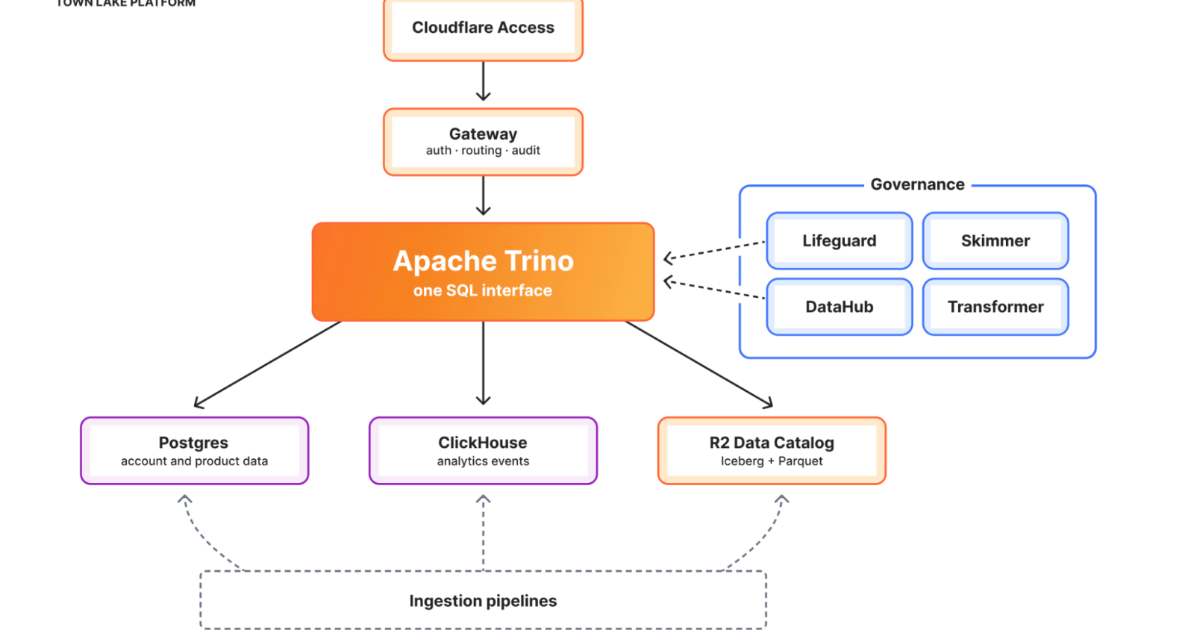
Cloudflare details Town Lake, an internal unified data platform, and Skipper, an AI analytics agent unifying access to operational, billing, security, and business data. The platform processed ~91K billing queries, with billing forming majority usage. Built on a lakehouse architecture using Trino, Iceberg, R2, and DataHub, it enables governed cross-system analytics and natural language access.
By Leela KumiliHardwood Promises High-Speed JVM Apache Parquet Processing with Zero Mandatory Dependencies

Hardwood, the project Gunnar Morling kick-started to improve the handling of Parquet files in Java, reached version 1. Its multi-threaded approach and zero mandatory external dependencies promise a simpler, optimal alternative to the Apache Parquet Java implementation. For now, the library provides a reading via API and a CLI for visualisation; writing support is expected in the upcoming versions.
By Olimpiu PopOpenTelemetry Graduates to CNCF's Highest Maturity Level

The Cloud Native Computing Foundation (CNCF) has announced the graduation of OpenTelemetry, elevating the project to the foundation's highest level of maturity and formally recognizing it as production-ready for enterprise use.
By Craig RisiMini book: Agentic AI Architecture

In this eMag, we try to establish agentic AI architecture as a new type of software architecture that will likely dominate the industry for years to come. The articles, written by industry experts, cover various elements and aspects of agentic AI architecture. We aim to present the latest trends and developments shaping the new type of architecture as it enters the mainstream.
By InfoQ
© 2026 Created by Michael Levin.
Powered by

