Codetown
Codetown ::: a software developer's community
OJUG ::: Git with Rusty
Event Details
Time: August 22, 2019 from 6pm to 8pm
Location: Starter Studio
Street: 101 S Garland Room 108
City/Town: Orlando
Website or Map: http://www.starterstudio.org
Phone: 3212529322
Event Type: meetup
Organized By: Michael Levin
Latest Activity: Aug 7, 2019
Event Description
Join us for a Git presentation featuring Rusty
Rusty Phillips has been a polyglot developer for over 20 years (and Java to some degree during all of that time), and has spent that time specializing
in not specializing - learning as much as possible in almost every
area of computer science and computer engineering. One of the few
areas that he has specialized in is configuring his environment to
suit the work that he's doing.
THE GIT STUFF:
1. Overview of version control features
- Locking checkout vs non-locking checkout
- distributed vs server-client
- Merge advantages of distributed
- Large binary disadvantage of distributed version control.
2. Git setup:
- ssh public/private keys; using ~/.ssh/config
- github, gitlab, bitbucket. (gitlab for demo)
- .gitconfig setup.
3. branches
4. commit vs push
5. fetch vs pull
6. The dangerous, common commands:
rebase, cherry-pick
7. Other important commands:
rm, reset, stash
8. merge vs mergetool, diff vs difftool
DEMO - commits with conflicts.
Other important areas:
1. Stealing dotfiles from the internet
(mine: tmux + nvim + oh-my-zsh + powerline).
2. CI/CD for gitlab via yaml file.
Stay tuned for details. Let me know if you’ll help out by sponsoring pizza. Thanks, Mike Levin
@mikelevin
Comment Wall
Comment
Happy 10th year, JCertif!
Notes
Welcome to Codetown!
 Codetown is a social network. It's got blogs, forums, groups, personal pages and more! You might think of Codetown as a funky camper van with lots of compartments for your stuff and a great multimedia system, too! Best of all, Codetown has room for all of your friends.
Created by Michael Levin Dec 18, 2008 at 6:56pm. Last updated by Michael Levin May 4, 2018.
Looking for Jobs or Staff?
Check out the Codetown Jobs group.
InfoQ Reading List
Instacart Scales Personalized Marketing via Configuration-Driven Multi-Tenant Platform

Instacart redesigned its personalized marketing system using a configuration-driven multi-tenant architecture on Storefront Pro. The system replaces retailer-specific implementations with a shared execution engine, enabling scalable personalization, faster configuration propagation in under a minute, and 99.9% delivery success across hundreds of retail banners through a unified campaign platform.
By Leela KumiliPresentation: Graph RAG: Building Smarter Retrieval Workflows with Knowledge Graphs

Cassie Shum discusses the architectural evolution of GraphRAG and why data foundations are critical for advanced AI workflows. She explains how traditional vector RAG falls short when addressing global context, multi-hop reasoning, and provenance. She shares enterprise strategies for building semantically structured knowledge graphs that shift raw orchestrating logic down to the data layer.
By Cassie ShumHeroUI v3 Lands as a Ground-Up Rewrite for React and React Native, Built on Tailwind CSS v4

HeroUI v3 is a redesigned React component library, previously NextUI, offering over 75 components, including 21 new ones, and a new React Native library with 37 components. Built on React Aria and Tailwind CSS v4, it emphasizes accessibility and customization. The library has experienced many updates since its release, and migration from the previous version is necessary.
By Daniel CurtisPresentation: The Infrastructure Challenge Behind Production AI

The panelists explain the realities of running AI systems reliably at scale. While building models is solved, maintaining production databases under constant pressure is not. They discuss the emerging architectural decisions separating teams that scale gracefully from those facing catastrophic outages, and what engineering leaders must rethink today.
By Simerus Mahesh, Alex Infanzon, Meryem Arik, Luca Bianchi, Renato LosioPresentation: Trustworthy Productivity: Securing AI-Accelerated Development
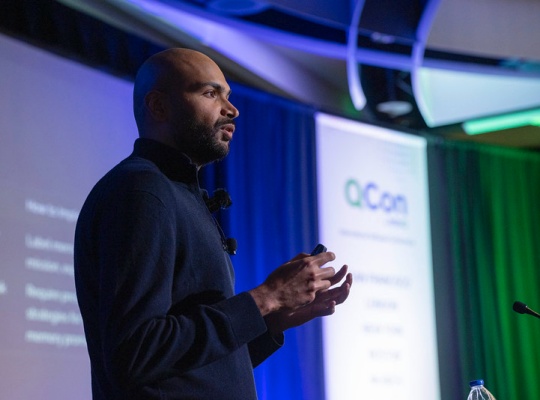
Sriram Madapusi Vasudevan discusses industry-converging patterns for securing autonomous AI agents in production. He explains the critical vulnerabilities hidden inside the ReAct loop across context, reasoning, and tool execution. He shares how to mitigate risks like memory poisoning and rogue tool execution using defense-in-depth strategies, LLM-as-a-judge critics, and MAESTRO threat modeling.
By Sriram Madapusi Vasudevan
© 2026 Created by Michael Levin.
Powered by


RSVP for OJUG ::: Git with Rusty to add comments!
Join Codetown