Codetown
Codetown ::: a software developer's community
AFRICA ANDROID CHALLENGE
Information
The Africa Android Challenge is on! The object is to learn and share your software development expertise...and to compete with your best Android application. Please join us and participate.
Location: Africa
Members: 3
Latest Activity: Mar 19, 2012
About the AFRICA ANDROID CHALLENGE
The Africa Android Challenge is all about the software development lifecycle. We'll go from concept to launch on each of the projects. The idea is to come up with a concept and develop it to completion.
We will share everything we learn. It's a great opportunity to learn about Android development and software development in general. You'll also build community by participating.
This group has discussions in the Discussion Forum, an RSS feed (the "Reading List"), a place to post comments and you'll see individual pages here, too.
Recognize Max Bonbhel, AfricaJUG and CongoJUG founder and coordinator in the photo above? That photo was taken at Google's Android headquarters during the JavaOne 2011 timeframe.
Thanks to Google for providing Android phones and assistance with this contest.
Discussion Forum
AFRICA ANDROID CHALLENGE - SUBMISSIONS ARE IN!
Check out these cool submissions to the Africa Android Challenge:…Continue
Tags: moroccojug, senejug, jug-africa, codetown, android
Started by Michael Levin Mar 19, 2012.
site 2 Replies
Hello I said what is the site for the challenge of africa androidContinue
Started by Ngadjeu. Last reply by Michael Levin Dec 21, 2011.
The Africa Android Challenge - First meeting 1 Reply
Here are some notes from the first meeting about The Africa Android Challenge. That's SeneJUG co-founder and coordinator Lamine…Continue
Tags: max bonbhel, codetown, contest, lamine ba, africa
Started by Michael Levin. Last reply by Max Bonbhel Dec 8, 2011.
Africa Android Challenge Reading List
Les livraisons mondiales de smartphones ont atteint un niveau plus bas depuis 14 ans avec une baisse de 20%, alors que les contraintes persistantes liée à l'IA en matière de mémoire restreignent l'offre
Les livraisons mondiales de smartphones ont atteint un niveau plus bas depuis 14 ans avec une baisse de 20 %, alors que les contraintes persistantes liée à l'IA en matière de mémoire restreignent l'offreLe marché mondial des smartphones a reculé de 20 % en glissement annuel au troisième trimestre 2026, atteignant son plus bas niveau pour un troisième trimestre depuis 14 ans, les pénuries persistantes de mémoire ayant restreint l'offre pour la plupart des équipementiers. Samsung a dominé le marché...
LineageOS 24, le système d'exploitation Android open source sans les services propriétaires de Google, intègre Android 17, de nouveaux outils WebUSB et des correctifs de sécurité
LineageOS 24, le système d'exploitation Android open source sans les services propriétaires de Google, intègre Android 17, de nouveaux outils WebUSB et des correctifs de sécuritéLineageOS a officiellement dévoilé la version 24.0, basée sur Android 17, la dernière version de Google, à peine trois mois avant que le projet ne fête son dixième anniversaire, le 24 décembre 2026. La nouveauté la plus importante pour les utilisateurs finaux prend la forme de nouveaux outils de flashage WebUSB basés sur...
Google confirme son intention de mettre fin à ChromeOS en 2034, son service d'assistance explique comment Googlebooks, basé sur Android, prendra le relais
Google confirme son intention de mettre fin à ChromeOS en 2034, tandis que son service d'assistance explique comment Googlebooks, basé sur Android, prendra le relaisUne nouvelle ère s'ouvre pour les ordinateurs portables de Google, puisque la société s'apprête à lancer la première vague de Googlebooks, qui fonctionnent sous un système d'exploitation basé sur Android. Google continuera toutefois à maintenir ChromeOS pendant plusieurs années encore, et la société a apporté des précisions sur la durée...
Pour ou contre les appareils connectés à domicile ? Des propriétaires déplorent la perte de leurs aliments suite à une MàJ de micrologiciel qui a rendu leurs réfrigérateurs intelligents Samsung inutilisables
Pour ou contre les appareils connectés à domicile ? Des propriétaires déplorent la perte de leurs aliments suite à une MàJ de micrologiciel qui a rendu leurs réfrigérateurs intelligents Samsung inutilisablesUne mise à jour défectueuse du micrologiciel via la plateforme SmartThings a rendu inopérants de nombreux réfrigérateurs intelligents Samsung, entraînant une perte de refroidissement et la détérioration de denrées alimentaires. Les gammes de réfrigérateurs connectés et dotés d'intelligence artificielle,...
Google s'est vu infliger une amende de 450 millions $ pour des manquements liés aux données de localisation, des fonctionnalités de localisation ayant été jugées contraires aux RGPD en Europe
Google s'est vu infliger une amende de 450 millions $ pour des manquements liés aux données de localisation, des fonctionnalités de localisation ayant été jugées contraires aux RGPD en EuropeLa Commission de protection des données (DPC) a infligé une amende de 403 millions d'euros à Google pour la manière dont l'entreprise a traité les données de localisation. Il s'agit de la première amende importante infligée à Google par l'autorité irlandaise de protection de la vie privée. Cette dernière amende...
Comment Wall
Comment
Happy 10th year, JCertif!
Notes
Welcome to Codetown!
 Codetown is a social network. It's got blogs, forums, groups, personal pages and more! You might think of Codetown as a funky camper van with lots of compartments for your stuff and a great multimedia system, too! Best of all, Codetown has room for all of your friends.
Created by Michael Levin Dec 18, 2008 at 6:56pm. Last updated by Michael Levin May 4, 2018.
Looking for Jobs or Staff?
Check out the Codetown Jobs group.
InfoQ Reading List
Optimizing Software Workflow: Exploring Fundamental Impacts in Technology

Software only has value when shipped; faster release cadence matters. Development, deployment, and operations require different thinking, metrics, and investments. There are four impacts in tech: product success, compute capacity, engineering capacity, and strategic innovation. The biggest expense is people. AI shifts engineers toward deeper problem understanding, not fewer engineers.
By Ben LindersPresentation: What 25 Trillion Tokens Reveal About How Developers Actually Adopt AI Agents

Brendan O'Leary discusses how real-world AI adoption depends on building trust rather than chasing model benchmarks. Drawing from 40 trillion tokens of usage data, he explains the four rungs of the AI adoption ladder and analyzes key failure points in context construction, multi-model routing, and feedback loops to help engineering leaders successfully scale agentic workflows.
By Brendan O’LearyGrafana Tempo 3.1 Adds Query-Based Trace Redaction and Sampling-Aware TraceQL Metrics

Grafana Labs has released Tempo 3.1, the first minor update to the 3.0 architecture. It adds TLS and additional SASL mechanisms to the Kafka client, lets operators redact traces with a TraceQL query instead of a list of trace IDs, and introduces an experimental query-time hint that corrects TraceQL metrics for sampled data.
By Claudio MasoloArticle: Server-Side DPoP and Token Exchange in Spring Security 7

Spring Authorization Server now lives inside Spring Security 7 under the same Maven coordinates, so the upgrade is a version bump. This server-side guide covers enabling DPoP and RFC 8693 Token Exchange, explains why 7.1 apps can silently stop enforcing DPoP until they call .dPoP(), and shows how to combine both into narrowed, sender-constrained tokens for service-to-service and agentic calls.
By Dhruv AgnihotriMeta Extends Confidential Computing to AI Glasses with Private Processing
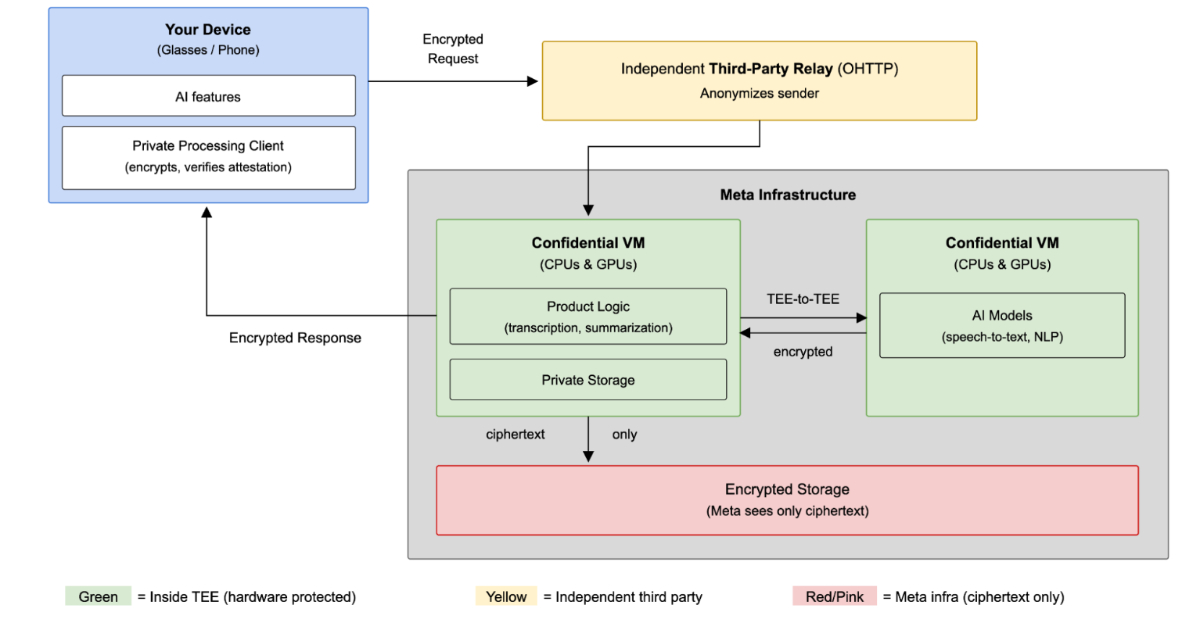
Meta has extended Private Processing to AI glasses, using confidential VMs, trusted execution environments, remote attestation, anonymous credentials, OHTTP routing, and TEE-based storage to process AI workloads and persistent user context in the cloud.
By Leela Kumili
© 2026 Created by Michael Levin.
Powered by


You need to be a member of AFRICA ANDROID CHALLENGE to add comments!