Codetown
Codetown ::: a software developer's community
AFRICA ANDROID CHALLENGE - SUBMISSIONS ARE IN!
Check out these cool submissions to the Africa Android Challenge:
http://www.androidchallenge.org/index.php?option=com_content&vi...
The Africa Android Challenge is an opportunity to discover the best developers and Android experts on the African continent. The contestants have an opportunity to create innovative applications and produce local "African" content. In addition, they can submit lectures related to Android on the Android Platform via the Google University Consortium Program.
This whole effort is community driven and is a way to assure the long-term success of African developers invested in the Android application environment. We also expect that such initiative will lead to the discovery of unexpected, rich, and valuable local content and applications.
Thanks to Lamine Ba for the heads up. Here's Lamine's Codetown profile: http://www.codetown.us/profile/LamineBa
Views: 60
Happy 10th year, JCertif!
Notes
Welcome to Codetown!
 Codetown is a social network. It's got blogs, forums, groups, personal pages and more! You might think of Codetown as a funky camper van with lots of compartments for your stuff and a great multimedia system, too! Best of all, Codetown has room for all of your friends.
Created by Michael Levin Dec 18, 2008 at 6:56pm. Last updated by Michael Levin May 4, 2018.
Looking for Jobs or Staff?
Check out the Codetown Jobs group.
InfoQ Reading List
Optimizing Software Workflow: Exploring Fundamental Impacts in Technology

Software only has value when shipped; faster release cadence matters. Development, deployment, and operations require different thinking, metrics, and investments. There are four impacts in tech: product success, compute capacity, engineering capacity, and strategic innovation. The biggest expense is people. AI shifts engineers toward deeper problem understanding, not fewer engineers.
By Ben LindersPresentation: What 25 Trillion Tokens Reveal About How Developers Actually Adopt AI Agents

Brendan O'Leary discusses how real-world AI adoption depends on building trust rather than chasing model benchmarks. Drawing from 40 trillion tokens of usage data, he explains the four rungs of the AI adoption ladder and analyzes key failure points in context construction, multi-model routing, and feedback loops to help engineering leaders successfully scale agentic workflows.
By Brendan O’LearyGrafana Tempo 3.1 Adds Query-Based Trace Redaction and Sampling-Aware TraceQL Metrics

Grafana Labs has released Tempo 3.1, the first minor update to the 3.0 architecture. It adds TLS and additional SASL mechanisms to the Kafka client, lets operators redact traces with a TraceQL query instead of a list of trace IDs, and introduces an experimental query-time hint that corrects TraceQL metrics for sampled data.
By Claudio MasoloArticle: Server-Side DPoP and Token Exchange in Spring Security 7

Spring Authorization Server now lives inside Spring Security 7 under the same Maven coordinates, so the upgrade is a version bump. This server-side guide covers enabling DPoP and RFC 8693 Token Exchange, explains why 7.1 apps can silently stop enforcing DPoP until they call .dPoP(), and shows how to combine both into narrowed, sender-constrained tokens for service-to-service and agentic calls.
By Dhruv AgnihotriMeta Extends Confidential Computing to AI Glasses with Private Processing
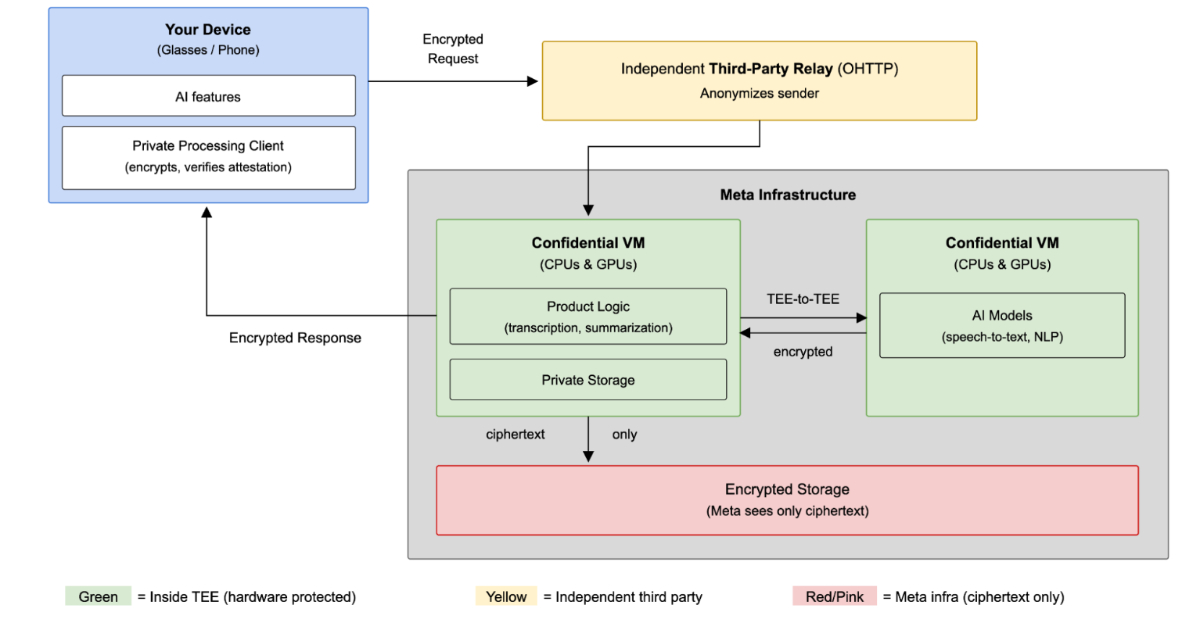
Meta has extended Private Processing to AI glasses, using confidential VMs, trusted execution environments, remote attestation, anonymous credentials, OHTTP routing, and TEE-based storage to process AI workloads and persistent user context in the cloud.
By Leela Kumili
© 2026 Created by Michael Levin.
Powered by

