Codetown
Codetown ::: a software developer's community
Ruby Town
Information
Ruby has made an impact on patterns of software development with its elegant syntax and Rails, an intelligent framework designed to simplify coding.
Members: 14
Latest Activity: Dec 5, 2012
About Ruby Town
Discussion Forum
Best Ruby I.D.E? 2 Replies
Just started with Ruby on Rails ( Rails 3) and I'm trying to figure out the best I.D.E. Here's what I've found so far:Eclipse / DLTK - while researching this on the web I came across a number of…Continue
Started by Kevin Neelands. Last reply by Kevin Neelands Dec 5, 2012.
Ruby Reading List
 Loading feed
Comment Wall
Comment
Happy 10th year, JCertif!
Notes
Welcome to Codetown!
 Codetown is a social network. It's got blogs, forums, groups, personal pages and more! You might think of Codetown as a funky camper van with lots of compartments for your stuff and a great multimedia system, too! Best of all, Codetown has room for all of your friends.
Created by Michael Levin Dec 18, 2008 at 6:56pm. Last updated by Michael Levin May 4, 2018.
Looking for Jobs or Staff?
Check out the Codetown Jobs group.
InfoQ Reading List
CircleCI Makes Machine Runner Orchestrator Generally Available

CircleCI has made its Machine Runner Orchestrator 1.0.0 generally available, providing automated scaling of self-hosted machine runner virtual machines according to CI workload demand.
By Craig RisiPresentation: Ontology‐Driven Observability: Building the E2E Knowledge Graph at Netflix Scale
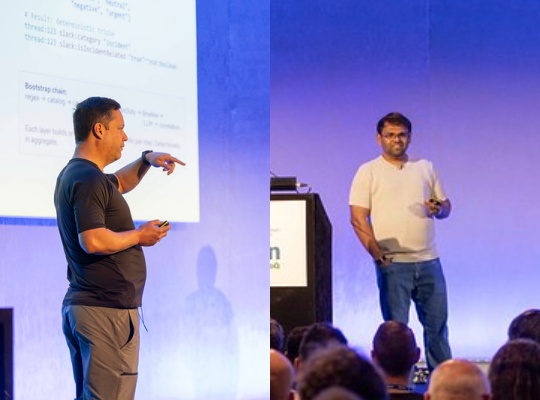
Prasanna Vijayanathan and Renzo Sanchez-Silva share how Netflix tackles observability across 38M events/sec. They discuss replacing reactive monitoring with an AI-driven operational ontology and agentic workflows using Claude and graph databases. They explain how unifying MELT telemetry into queryable knowledge graphs enables automated triaging, root-cause analysis, and self-healing systems.
By Prasanna Vijayanathan, Renzo Sanchez-SilvaOlson and Söderqvist Discuss Valkey’s Evolution and Future Past Caching Use Cases at OSS EU

Valkey is a growing project, launched as a fork of Redis over two years ago, supported by twelve maintainers and nine committee members from various companies. Recent developments include enhanced throughput, improved cluster functionality, and plans for features like synchronous replication and tiered storage. The project also emphasises security and release efficiency through automation.
By Olimpiu PopPodcast: The Minimum Viable Manager: Building Trust, Feedback, and Alignment
In this podcast, Shane Hastie, Lead Editor for Culture & Methods, spoke to Matt Gjertsen, founder of Built and author of Minimum Viable Manager, about the three foundational skills every first-time manager needs, how to build trust and give effective feedback, and why human leadership skills matter even more in the age of AI.
By Matt GjertsenHashiCorp Relased Terraform Google Cloud Provider 8.0 in General Availability

HashiCorp has announced the general availability of version 8.0 of the Terraform provider for Google Cloud. The major release updates the default load balancing for two Compute Engine resources. It also removes resources linked to retired Google Cloud services.
By Claudio Masolo
© 2026 Created by Michael Levin.
Powered by


You need to be a member of Ruby Town to add comments!