Codetown
Codetown ::: a software developer's community
iPhone & Mac Developers GOTO Conference in Atlanta Feb 21 to 24, 2010
- iPhone: Feb 21
- Mac: Feb 22 to 23
- Optional Workshops: Feb 24
Views: 147
Replies to This Discussion
-
Permalink Reply by Kevin Collins on
-
Hi Walt,
Thanks for sharing this information. Have you ever been to one of their conferences? I am new at iPhone development and just released my first app, Party Twacker, December 11, 2009. I live in Jacksonville, FL and was thinking this conference might be worth the trip. -
-
Permalink Reply by Walt Sellers on
-
I have not been to any conferences by these guys. I heard about the conference on the "Core Intuition" podcast (episode 25, near the end I think.) They had positive things to say about it. If nothing else, it should be a great way to meet a lot of other iPhone developers in a short time. Unlike WWDC, they are much more likely to be local to the southeast US.
I have heard about the Big Nerd Ranch for quite some time. I was introduced to Aaron Hillegass at a WWDC by a friend who was working on a Mac Developers website. He's always easy to spot in the over-sized hat. He's been teaching Cocoa to developers since the NeXT days. They have powerful courses and the fees cover everything except airfare. You stay in their facility full-time for the duration of the course. And it is based in Atlanta. (No, I'm not paid to advertise them.)
I have been to many WWDC's (but not the last 3 due to circumstance). They are awesome and I recommend them. I understand they have morphed quite a bit recently as much of the audience turns to iPhone development. But just the sheer number and quality of the other attendees makes it a great experience.
However, the WWDC is expensive. $1,500 for the fee the last time I looked and the hotel bill can easily get close to that if you aren't careful. Then ad airfare and 1 or 2 meals per day (lunch is usually included, sometimes dinner, and some snacking in between.) -
Happy 10th year, JCertif!
Notes
Welcome to Codetown!
 Codetown is a social network. It's got blogs, forums, groups, personal pages and more! You might think of Codetown as a funky camper van with lots of compartments for your stuff and a great multimedia system, too! Best of all, Codetown has room for all of your friends.
Created by Michael Levin Dec 18, 2008 at 6:56pm. Last updated by Michael Levin May 4, 2018.
Looking for Jobs or Staff?
Check out the Codetown Jobs group.
InfoQ Reading List
Android Bench 2 Adds Support for Long-Horizon Tasks, Agentic Evaluation, and Continuous Scoring

Google has released Android Bench 2.0, a major update to its benchmark framework for evaluating AI models and agents on Android development tasks. The update introduces long-horizon tasks (LHTs), agent-based evaluation, and continuous scoring to better assess performance on complex, multi-step development tasks.
By Sergio De SimoneShopify Upgrades Checkout Blocks to Polaris Web Components, Cutting Bundle Sizes up to 85%

Shopify has updated its Checkout Blocks app, transitioning five high-traffic checkout UI extensions to remote-dom using Preact and Polaris web components. The rewrite, which involved moving to TypeScript and a new API version, led to significant reductions in bundle sizes and load times. From October 1, 2026, only the updated versions will be supported.
By Daniel CurtisGithub Migrates Copilot Runtime to Rust with AI-Assisted Rewrite
GitHub migrated more than 800,000 lines of Copilot runtime code from TypeScript and Node.js to Rust in about 14.5 weeks using AI-assisted development. The incremental migration used N-API interoperability, automated testing, human review, and 128 pull requests while continuing to ship releases.
By Leela KumiliCircleCI Makes Machine Runner Orchestrator Generally Available
CircleCI has made its Machine Runner Orchestrator 1.0.0 generally available, providing automated scaling of self-hosted machine runner virtual machines according to CI workload demand.
By Craig RisiPresentation: Ontology‐Driven Observability: Building the E2E Knowledge Graph at Netflix Scale
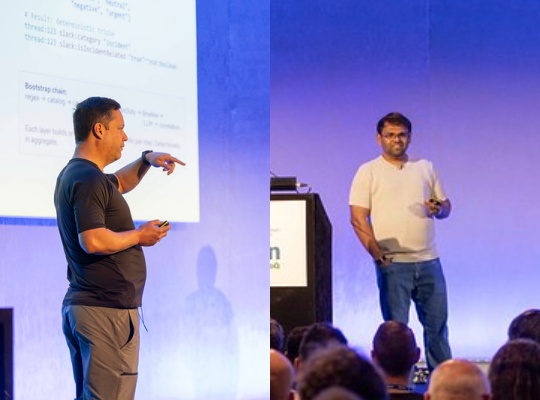
Prasanna Vijayanathan and Renzo Sanchez-Silva share how Netflix tackles observability across 38M events/sec. They discuss replacing reactive monitoring with an AI-driven operational ontology and agentic workflows using Claude and graph databases. They explain how unifying MELT telemetry into queryable knowledge graphs enables automated triaging, root-cause analysis, and self-healing systems.
By Prasanna Vijayanathan, Renzo Sanchez-Silva
© 2026 Created by Michael Levin.
Powered by

