Codetown
Codetown ::: a software developer's community
OrlandoJUG - What’s New in Java 9, 10, and 11
Event Details
Time: September 27, 2018 from 6pm to 8pm
Location: Starter Studio at Church Street Station
Street: 101 S Garland Ave Suite 108
City/Town: Orlando, FL
Website or Map: http://www.orlandojug.com
Phone: 321-252-9322
Event Type: meetup
Organized By: Michael Levin
Latest Activity: Sep 26, 2018
Event Description
Hi!
Join us to look at what’s new in Java 9, 10 and 11. Also, to understand the new Java release cycle. Jim’s the point man on that and also a JavaFX expert, so there’s a chance to ask some other questions.
Agenda,
1) New Java Release Cadence
2) What’s new in Java 9
3) What’s new in Java 10
4) What’s new in Java 11
Jim is a Master Sales Consultant in Oracle’s Java Group.
His primary role is to advise Fortune 500 companies on best Java security practices and Java Roadmap planning.
He has spent the past 20 years, starting with Sun Microsystems,
working with Java specializing in distributed Object and UI technologies.
Jim is the primary author of the book, “JavaFX: Developing Rich Internet Applications”.
Of course, we’ll have great pizza and bevs (thanks to Oracle this time!) and be sure to RSVP because that’s how we determine how much to buy.
Comment Wall
Comment
Happy 10th year, JCertif!
Notes
Welcome to Codetown!
 Codetown is a social network. It's got blogs, forums, groups, personal pages and more! You might think of Codetown as a funky camper van with lots of compartments for your stuff and a great multimedia system, too! Best of all, Codetown has room for all of your friends.
Created by Michael Levin Dec 18, 2008 at 6:56pm. Last updated by Michael Levin May 4, 2018.
Looking for Jobs or Staff?
Check out the Codetown Jobs group.
InfoQ Reading List
AWS Introduces Amazon S3 Annotations

AWS recently announced Amazon S3 Annotations, a feature that lets teams attach rich, searchable context such as summaries, classifications, compliance data, or AI-generated insights directly to S3 objects. Annotations can be updated independently of the object and queried across datasets, reducing the need for separate metadata systems.
By Renato LosioClaude Reaches GA on Microsoft Foundry: European Enterprises Cannot Deploy It

Claude models reached GA on Microsoft Foundry with Azure-native billing and governance, but no European data zone exists. Anthropic's own documentation confirms data residency guarantees apply to Bedrock and Vertex AI but not Foundry. European practitioners from banking and healthcare report the offering is unapproved for production.
By Steef-Jan WiggersCycle Introduces EU Control Plane as Sovereignty Debate Continues

Cycle recently introduced a separate EU-based control plane, allowing European customers to keep platform management data and telemetry within Europe. The new offering is designed to improve compliance, operational isolation, and responsiveness for European organizations.
By Renato LosioCloudflare Details Unified Data Platform Where Billing Workloads Account for 53% of Queries
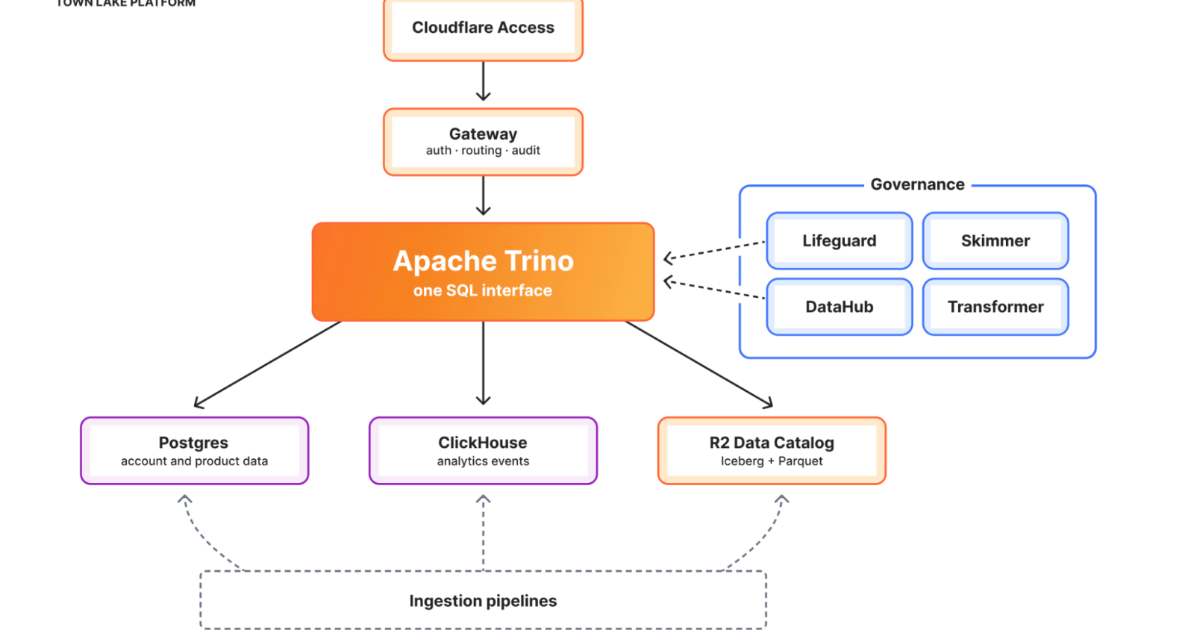
Cloudflare details Town Lake, an internal unified data platform, and Skipper, an AI analytics agent unifying access to operational, billing, security, and business data. The platform processed ~91K billing queries, with billing forming majority usage. Built on a lakehouse architecture using Trino, Iceberg, R2, and DataHub, it enables governed cross-system analytics and natural language access.
By Leela KumiliHardwood Promises High-Speed JVM Apache Parquet Processing with Zero Mandatory Dependencies

Hardwood, the project Gunnar Morling kick-started to improve the handling of Parquet files in Java, reached version 1. Its multi-threaded approach and zero mandatory external dependencies promise a simpler, optimal alternative to the Apache Parquet Java implementation. For now, the library provides a reading via API and a CLI for visualisation; writing support is expected in the upcoming versions.
By Olimpiu Pop
© 2026 Created by Michael Levin.
Powered by


RSVP for OrlandoJUG - What’s New in Java 9, 10, and 11 to add comments!
Join Codetown