Codetown
Codetown ::: a software developer's community
GatorJUG - Slashdot's Tim Lord
Event Details
Time: May 13, 2015 from 6pm to 8pm
Location: Santa Fe College Rm S326
Street: 3000 NW 83 St, Gainesville, FL 32606 (352) 395-5000
City/Town: Gainesville
Website or Map: http://www.sfcollege.edu/loca…
Phone: 321-252-9322
Event Type: meeting
Organized By: Michael Levin @mikelevin
Latest Activity: May 12, 2015
Event Description
This month we have a special guest: Tim Lord, Senior Editor of Slashdot!
This is going to be an awesome presentation. Tim's a lot of fun and he's been with Slashdot for a long time.
How long? Here's a bio from a 2006 OhMyNews article: "Tim Lord ("timothy" on Slashdot) is one of the site's editors, and for more than five years served as the site's managing editor; he has selected and posted close to 13,000 of the stories that have appeared on Slashdot (almost all of which are reader-submitted commentary on computer and other technical news), coordinated interviews with reader--submitted and--moderated questions, and collaborated with amateur reviewers on hundreds of book reviews. Lord graduated in 1998 from the University of Texas at Austin, and is currently a JD candidate at Temple Law School in Philadelphia."
Tim will show you how the Slashdot editors pick stories, cull spam, and attempt (mostly successfully!) to prevent duplicate stories from hitting the page. He'll do some live editing and story picking, too.
Tim is driving from Austin to Gainesville! It's going to be an epic trip. We are all in for a treat.
Also, I have one ticket to Open Source Bridge to raffle off. I've been to the conference in Portland and I loved it!
Comment Wall
Comment
Happy 10th year, JCertif!
Notes
Welcome to Codetown!
 Codetown is a social network. It's got blogs, forums, groups, personal pages and more! You might think of Codetown as a funky camper van with lots of compartments for your stuff and a great multimedia system, too! Best of all, Codetown has room for all of your friends.
Created by Michael Levin Dec 18, 2008 at 6:56pm. Last updated by Michael Levin May 4, 2018.
Looking for Jobs or Staff?
Check out the Codetown Jobs group.
InfoQ Reading List
InfoQ Online Certification Program: New AI Engineering and Organizational Architecture Cohorts
InfoQ expands its online certification portfolio with new AI Engineering and Organizational Architecture cohorts, giving senior practitioners a confidential peer group to pressure-test production AI, platform, team design, and architecture decisions.
By Artenisa ChatziouPresentation: Realtime and Batch Processing of GPU Workloads
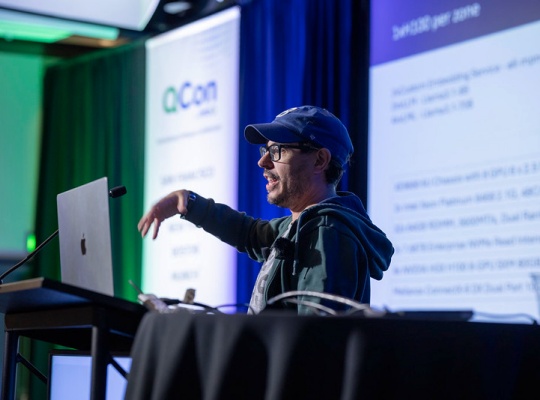
Joseph Stein discusses engineering an enterprise AI-as-a-Service platform within a private cloud data center. He explains how to maximize underutilized GPU pools via multi-namespace scheduling, leverage Valkey and Lua for atomic priority queuing and backpressure management, mitigate OWASP Top 10 LLM risks via central proxy gateways, and scale batch pipelines using a custom S3-to-Kafka proxy.
By Joseph SteinGoogle Expands SynthID Adoption for AI Watermarking, Previews Content Detection API

Google's SynthID, designed to embed imperceptible signals into AI-generated content, is adding a new Content Detection API on Google Cloud's Gemini Enterprise Agent Platform, after gaining adoption by several industry players including Nvidia and OpenAI.
By Sergio De SimoneTamboUI Promises to Bring Better Capabilities to Build TUIs in Java

The call to action, “to make 2026 the year of Java in the terminal,” was quickly responded to by the launch of TamboUI. Inspired by Ratatui, the library used in Claude CLI, it promises support ranging from low-level terminal drawing to high-level APIs such as components and event handling. Currently at version 0.3.0, it has already been adopted by major projects such as Maven and Spring.
By Olimpiu PopArticle: Architecting Cloud-Native Kafka: From Tiered Storage Towards a Diskless Future

This article explores Kafka's transition toward a cloud-native architecture, examining how tiered storage, FinOps telemetry, elastic consumer scaling, virtual clusters, and Share Groups reshape the operational and economic model of event streaming platforms. It also analyzes emerging diskless-storage proposals and their architectural trade-offs.
By Viquar Khan
© 2026 Created by Michael Levin.
Powered by


RSVP for GatorJUG - Slashdot's Tim Lord to add comments!
Join Codetown