Codetown
Codetown ::: a software developer's community
Whats the best iPhone development environment?
Views: 246
Replies to This Discussion
-
Permalink Reply by Robert Hedin on
-
If you're wanting to write for the App Store, XCode is pretty much it. All of the iPhone libraries are either Objective-C (user interface) with some C level under pinnings.
As far as books go, to be honest I don't believe anything really talks about the current 3.1 OS, so I'm a bit hesitant to recommend anything today. The Apple docs on the dev site aren't too bad.
rob. -
-
Permalink Reply by Kevin Neelands on
-
Mara said:
Let's just say I've been better.how are you -
-
Permalink Reply by Walt Sellers on
-
If you look at some of the developer agreements, at least one of them specified that the software must be developed on a Mac.
The Mac Mini is the cheapest to buy new, but any Intel-based Mac will do. I recommend against any of the single-core Macs myself.
I've read Zdziarski's "iPhone Forensics" book and it was really good. (Perhaps outdated now.) And its an O'Reilly book. So his other books might also be good.
I've looked through a "cookbook" in the bookstore. It seemed really straight-forward, except that it kept mentioning things that were not in the public API's (Apple's agreements require using only public API's in apps for the App Store.)
Aaron Hillegass and the Big Nerd Ranch have been doing Cocoa training and books for many years. His Cocoa and Mac OS X books are very good. (Objective-C is rolled up in there too.)
Once you have your developer account with Apple, you can access some videos on iPhone programming.
There are some alternative iPhone App generators out there, but they are usually specific to games and such. Apparently Adobe has a Flash-to-iPhone app generator as well. (Turns a flash show into a stand-alone app.)
It is possible to do Objective-C coding with any computer that can run the gcc compiler. I've seen a friend using it to write Objective-C on a Linux box (intending to transfer to a Mac sometime later.) However, that does not include the Cocoa frameworks that ship with the Apple OS's.
XCode does have some very good features for programming on iPhone or Mac. In particular, the code-completion feature makes entering the very-long method names very easy. (Not only do you know there is no typo in the name, but the argument list is completed as well.) -
-
-
Thanks! I'll start looking at getting a mac and diving into this.
-
-
-
Hi Kevin,
I noticed that, like me, you are getting into iPhone development.
I joined the iPhone Development group and pretty new to iPhone development. I am looking to network with other developers, share my experiences and learn from others. I have been an applications developer for a large corporations in Jax, FL for more than 25 years. I got involved with iPhone development as a fall back due to many layoffs at my company. Fortunately I am still employed and enjoying working with Apple's XCODE SDK.
I just released my first iPhone App, Party Twacker, on December 11, 2009. If you ever get stumped on and iPhone dev issues, feel free to send me a message.
Take Care,
Kevin Collins -
-
-
I checked out the party Twacker - cool! Sadly, I am not into the bar or even the drinking scene anymore, but if I was I'm sure I'd use it. You can see some of my stuff here:
http://user.gru.net/nemesis/iphoneAppPages/ -
-
-
You have been busy! Six apps already in iTunes. That's impressive. I am not trying to get personal but how has your marketing been going? I am in the process of publishing a Lite Version of my app to try get more interested buyers. With the App Store not having a return policy, people are more reluctant to purchase apps. I am checking out your apps now and they look really cool. Best of Luck with your Apps.
Kevin
Kevin Neelands said:I checked out the party Twacker - cool! Sadly, I am not into the bar or even the drinking scene anymore, but if I was I'm sure I'd use it. You can see some of my stuff here:
http://user.gru.net/nemesis/iphoneAppPages/ -
-
-
How's marketing going? I'm earning enough to treat myself to delivery pizza once a week. I *think* good reviews help the marketing process, so if you enjoy and of my apps please write one! The picture-kaleidoscope is a rather good fit with party twacker - take a photo of a cute girl, create a a kaleidoscope image of her, and she'll be tickled pink!
-
Happy 10th year, JCertif!
Notes
Welcome to Codetown!
 Codetown is a social network. It's got blogs, forums, groups, personal pages and more! You might think of Codetown as a funky camper van with lots of compartments for your stuff and a great multimedia system, too! Best of all, Codetown has room for all of your friends.
Created by Michael Levin Dec 18, 2008 at 6:56pm. Last updated by Michael Levin May 4, 2018.
Looking for Jobs or Staff?
Check out the Codetown Jobs group.
InfoQ Reading List
Artifactory Vulnerabilities Under Active Exploitation Enable Authentication Bypass and Admin Access

Three Artifactory vulnerabilities under active exploitation enable authentication bypassing on Internet-accessible, self-hosted deployments, potentially allowing attackers to establish persistent administrator access in under five minutes. The exploits then enable dangerous activity, including credential and key theft, arbitrary code execution, persistence, and anti-forensics measures.
By Sergio De SimoneRadicle Discloses Critical Flaws Exposing Private Repositories in Plain Text

Radicle has identified two critical security vulnerabilities in its wire protocol, compromising confidentiality across all node releases. Attackers can access private repository data in cleartext and impersonate nodes. Due to architectural flaws, immediate halting of clearnet operations is advised. Fixes will require a shift to a new protocol (Iroh), creating backward incompatibility issues.
By Olimpiu PopMeta’s ZGateway Cuts ZippyDB Connections 19x While Handling 1B+ Operations per Second
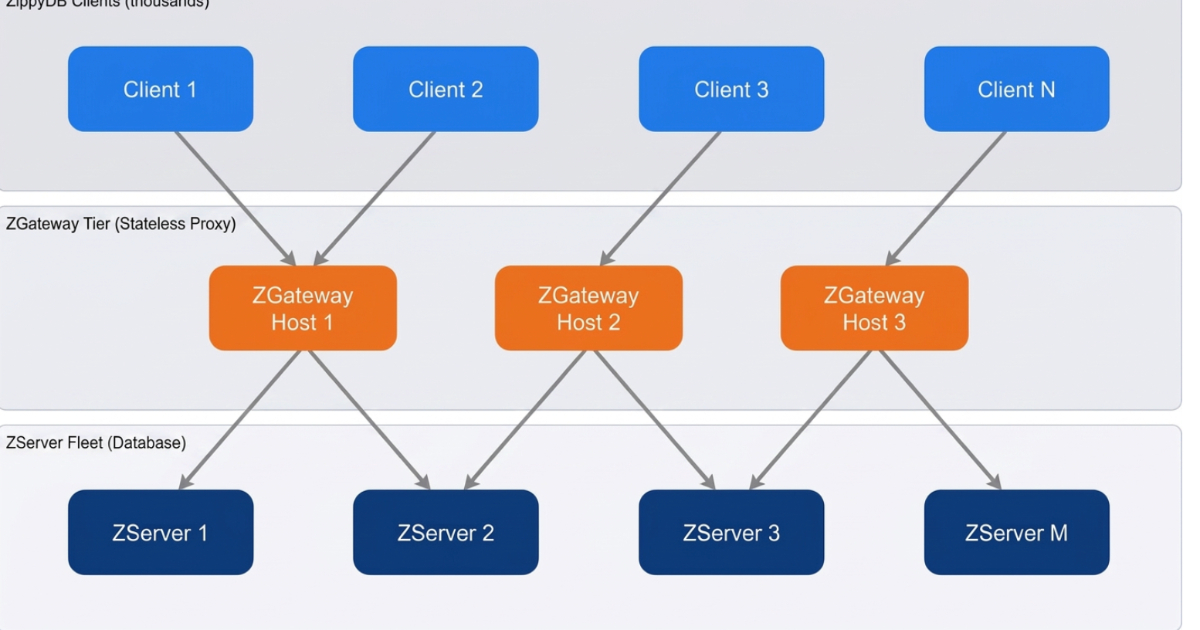
Meta has introduced ZGateway, a stateless proxy for ZippyDB that centralizes connection management, traffic routing, caching, load balancing, and admission control. The gateway handles more than 1 billion operations per second and about 40% of ZippyDB traffic, while Meta’s model estimates a 19x reduction in persistent connections.
By Leela KumiliPresentation: From Consumers to Builders: Turning 200 of our Team into Agent Creators in 2 Weeks

Ben Maraney shares how Forter demystified AI agent creation for technical and non-technical staff. He discusses leveraging custom MCP servers, combining no-code and code-based platforms, sidestepping complex RAG setups, and aligning security and legal teams to accelerate internal agent adoption across R&D.
By Ben MaraneyPodcast: The AI Revolution Fails Without Psychological Safety For Developers: A Conversation with Erin Doyle

In this podcast, Michael Stiefel spoke to Erin Doyle about how artificial intelligence tools are transforming the software development process, and how they are affecting software engineers. Architecture skills are now critical because engineers need to understand how to build systems and handle the constraints and associated ambiguity in the requirements.
By Erin Doyle
© 2026 Created by Michael Levin.
Powered by

