Codetown
Codetown ::: a software developer's community
Some thoughts on licensing from Google's Chris DiBona
Chris DiBona is the director of open source at Google, and he's been taking a big part in the open source and Free software ecosystem for a very long time--not least in his role with Google's Summer of Code. He recently posted on Twitter what he calls "a little rant" about software licensing -- well worth reading the whole (short!) thing.
Upshot: Be cautious and humble in selecting a software license; ones that have been around and used happily by others have advantages, including familiarity to users. This applies to open source licenses, but maybe not so surprisingly at least as much to licenses that offer some of the qualities of open source (availability of code) without all the freedoms that FOSS developers have come to expect.
New licenses, especially ones with complex restrictions on use, can make users shy away from them.
Comment
Happy 10th year, JCertif!
Notes
Welcome to Codetown!
 Codetown is a social network. It's got blogs, forums, groups, personal pages and more! You might think of Codetown as a funky camper van with lots of compartments for your stuff and a great multimedia system, too! Best of all, Codetown has room for all of your friends.
Created by Michael Levin Dec 18, 2008 at 6:56pm. Last updated by Michael Levin May 4, 2018.
Looking for Jobs or Staff?
Check out the Codetown Jobs group.
InfoQ Reading List
How Shopify Orchestrates AI-Powered Mobile App Development Without Overloading Developers' Machines

To prevent AI development workflows from exhausting developer machines' resources, Shopify built Remote Dev, a remote mobile development environment that enables AI agents to independently build, test and maintain iOS and Android applications and in parallel.
By Sergio De SimoneQwik 2.0 RC: Replaces HTML Comment Markers for Faster Reactivity and Out-of-Order Streaming

Qwik 2.0 Release Candidate, published on 1 October 2026, replaces v1's HTML comment markers with two script blocks that hold state and virtual node data. It adds experimental out-of-order streaming, async useComputed$, and cacheable route loaders. Qwik's benchmarks show v2 at 1.23x vanilla JavaScript, versus 2.59x for v1. A migration command is provided.
By Daniel CurtisDatadog Brings Production Experimentation to AI Agent Observability

Datadog is extending its Agent Observability platform with Online Experiments, allowing engineering teams to compare AI agent versions against real production traffic rather than relying exclusively on predefined evaluation datasets.
By Craig RisiPresentation: Scaling LLM-Based Ranking Systems for Latency-Critical Search & Recommendation Workloads

Sundara Raman Ramachandran shares how LinkedIn productionizes LLM ranking under strict P99 latency SLAs. He discusses distilling a 7B model down to 400M parameters, compressing job contexts into single-token embeddings for a 10x throughput leap, and eliminating hidden system bottlenecks - from custom flash attention masks to Python GIL workarounds, gc.freeze, and non-blocking CUDA memory copies.
By Sundara Raman RamachandranProduction AI, Architecture Trade-offs & Team Design: InfoQ Opens Registration for 6 January Cohorts
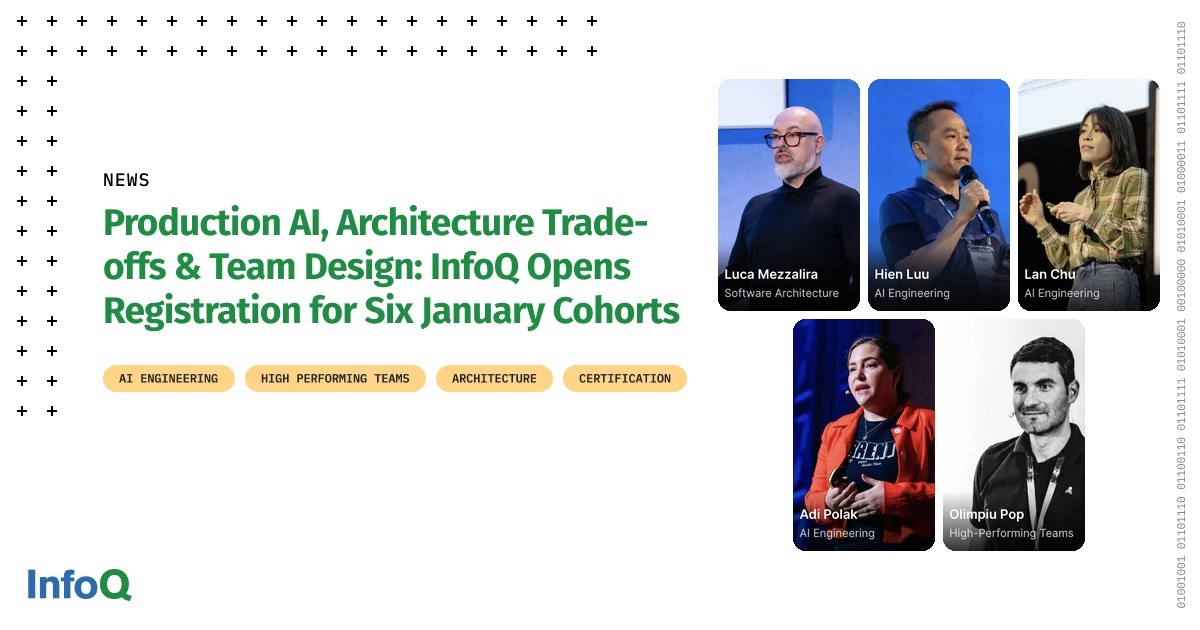
From agent reliability to architecture decisions and delivery bottlenecks, InfoQ’s January 2027 cohorts give senior practitioners five weeks to examine current challenges, test approaches in their own work, and compare results with peers.
By Artenisa Chatziou
© 2026 Created by Michael Levin.
Powered by


You need to be a member of Codetown to add comments!
Join Codetown