Codetown
Codetown ::: a software developer's community
Swampcast features Jonathan Schwartz, former Sun CEO
Join Michael Levin in this video interview with Jonathan Schwartz, former Sun Microsystems CEO. "Jonathan Ian Schwartz (born October 20, 1965) is an American...
Comment
-
Comment by Michael Levin on August 7, 2019 at 5:26am
-
Wikipedia ::: Swampcast podcast features Brion Vibber, Wikipedia CTO
Here’s a blast from the past. Wikipedia CTO Brion Vibber walks us through the beginnings of Wikipedia. Enjoy! Click here to hear the podcast.
-
-
Swampcast features Tim Westergren, Pandora CEO
Join Michael Levin in this Swampcast interview with Tim Westergren, Pandora CEO. Click here to listen. Photo credit: Gala
In 2007, Tim started touring the USA giving presentations about a new music service on the web called Pandora. I met Tim in Orlando. There's quite a bit of background about Pandora that Tim describes in this interview. He deferred to his CTO, Tom Conrad when I asked him about technical details. Tom and I did a Swampcast interview shortly after this one.
From Wikipedia:
In 1999 Westergren started Pandora Media along with two co-founders: Will Glaser and Jon Kraft. The Oakland, Calif., company went public in 2011,[3] reporting $138 million in revenue that fiscal year.
As an early project, Westergren and Glaser created the Music Genome Project, a mathematical algorithm to organize music.[1] As the company's chief strategy officer, Westergren spends the majority of his time traveling the nation and gathering feedback from Pandora Radio users. In 2010 he was listed by Time magazine as one among the 100 most influential people in the world.[4]
In April 2016, Pandora Media announced that Tim Westergren would replace Brian McAndrews as CEO. He had previously served as CEO and president from May 2002 to July 2004.[5]
In June 2017, he announced that he is going to step down as CEO.[6]"
-
-
This is one of the most deeply technical Swampcasts - fascinating!
https://codetown.com/profiles/blogs/pandora-swampcast-features-pand...
#pandora #tomconrad #swampcast #mikelevin
-
-
Here's a Swampcast featuring Craig Newmark, founder of Craigslist. Enjoy!
Happy 10th year, JCertif!
Notes
Welcome to Codetown!
 Codetown is a social network. It's got blogs, forums, groups, personal pages and more! You might think of Codetown as a funky camper van with lots of compartments for your stuff and a great multimedia system, too! Best of all, Codetown has room for all of your friends.
Created by Michael Levin Dec 18, 2008 at 6:56pm. Last updated by Michael Levin May 4, 2018.
Looking for Jobs or Staff?
Check out the Codetown Jobs group.
InfoQ Reading List
Android Bench 2 Adds Support for Long-Horizon Tasks, Agentic Evaluation, and Continuous Scoring

Google has released Android Bench 2.0, a major update to its benchmark framework for evaluating AI models and agents on Android development tasks. The update introduces long-horizon tasks (LHTs), agent-based evaluation, and continuous scoring to better assess performance on complex, multi-step development tasks.
By Sergio De SimoneShopify Upgrades Checkout Blocks to Polaris Web Components, Cutting Bundle Sizes up to 85%

Shopify has updated its Checkout Blocks app, transitioning five high-traffic checkout UI extensions to remote-dom using Preact and Polaris web components. The rewrite, which involved moving to TypeScript and a new API version, led to significant reductions in bundle sizes and load times. From October 1, 2026, only the updated versions will be supported.
By Daniel CurtisGithub Migrates Copilot Runtime to Rust with AI-Assisted Rewrite
GitHub migrated more than 800,000 lines of Copilot runtime code from TypeScript and Node.js to Rust in about 14.5 weeks using AI-assisted development. The incremental migration used N-API interoperability, automated testing, human review, and 128 pull requests while continuing to ship releases.
By Leela KumiliCircleCI Makes Machine Runner Orchestrator Generally Available
CircleCI has made its Machine Runner Orchestrator 1.0.0 generally available, providing automated scaling of self-hosted machine runner virtual machines according to CI workload demand.
By Craig RisiPresentation: Ontology‐Driven Observability: Building the E2E Knowledge Graph at Netflix Scale
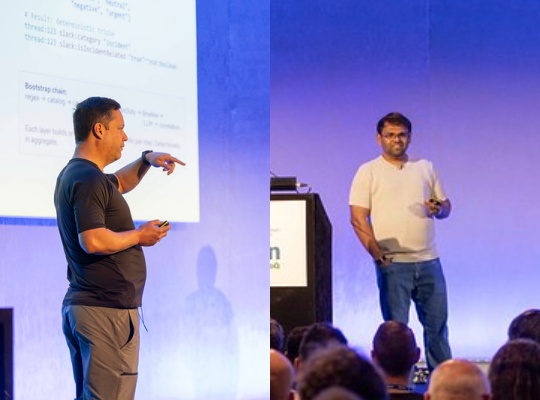
Prasanna Vijayanathan and Renzo Sanchez-Silva share how Netflix tackles observability across 38M events/sec. They discuss replacing reactive monitoring with an AI-driven operational ontology and agentic workflows using Claude and graph databases. They explain how unifying MELT telemetry into queryable knowledge graphs enables automated triaging, root-cause analysis, and self-healing systems.
By Prasanna Vijayanathan, Renzo Sanchez-Silva
© 2026 Created by Michael Levin.
Powered by


You need to be a member of Codetown to add comments!
Join Codetown