Codetown
Codetown ::: a software developer's community
My sensor project is ProSense
Did you know there is a project called ProSense?
It's funded by European Commission's Seventh Framework Programme (FP7),
and it's aim is to raise the level of research potential of researchers from WBC
(Western Balkan Countries), particularly ones from FYRO Macedonia and Serbia
with help from the EU academic institutions and companies.
The project coordinator is Dr. Srdjan Krčo (Ericsson Ireland Research Centre).
Other partners are:
- Faculty of Electrical Engineering and Information Technologies, Macedonia
- INRIA, France
- University of Birmingham, UK
- Warsaw University of Technology, Poland
- CTI, Patras, Greece
- University of Belgrade, Serbia
- Jozef Stefan Institute, Slovenia
The project motto is:
"Promote, Mobilize, Reinforce and Integrate
Wireless Sensor Networking Research and Researchers:
Towards Pervasive Networking of West Balkan Countries and the EU"
The project started a year ago and it should end in March 2010.
I work as a part-time researcher at the School of Electrical Engineering (ETF),
University of Belgrade, Serbia. The team that I am part of has to design two WSN use-cases
- two Personal Health applications. Also, we have to establish a course and a laboratory for WSN at ETF.
We have several SunSPOT, Shimmer and Sensinode Development Kits to play with (since few weeks).
That's it for an introduction, now go on and browse our site and get back with comments!
Marko Stanković
Comment
-
Comment by Michael Levin on July 4, 2012 at 2:19pm
-
Marko, I noticed the sensor project ProSense has ended, or has it? I have worked with sensors including the SunSPOT. There's a lot of talk from some corners about SunSPOTs. What are a few of the most outstanding things you've learned so far? Best, Michael
Happy 10th year, JCertif!
Notes
Welcome to Codetown!
 Codetown is a social network. It's got blogs, forums, groups, personal pages and more! You might think of Codetown as a funky camper van with lots of compartments for your stuff and a great multimedia system, too! Best of all, Codetown has room for all of your friends.
Created by Michael Levin Dec 18, 2008 at 6:56pm. Last updated by Michael Levin May 4, 2018.
Looking for Jobs or Staff?
Check out the Codetown Jobs group.
InfoQ Reading List
AGNTCon + MCPCon 2026: Agentic AI Foundation Adds Four Projects as MCP Turns to Security
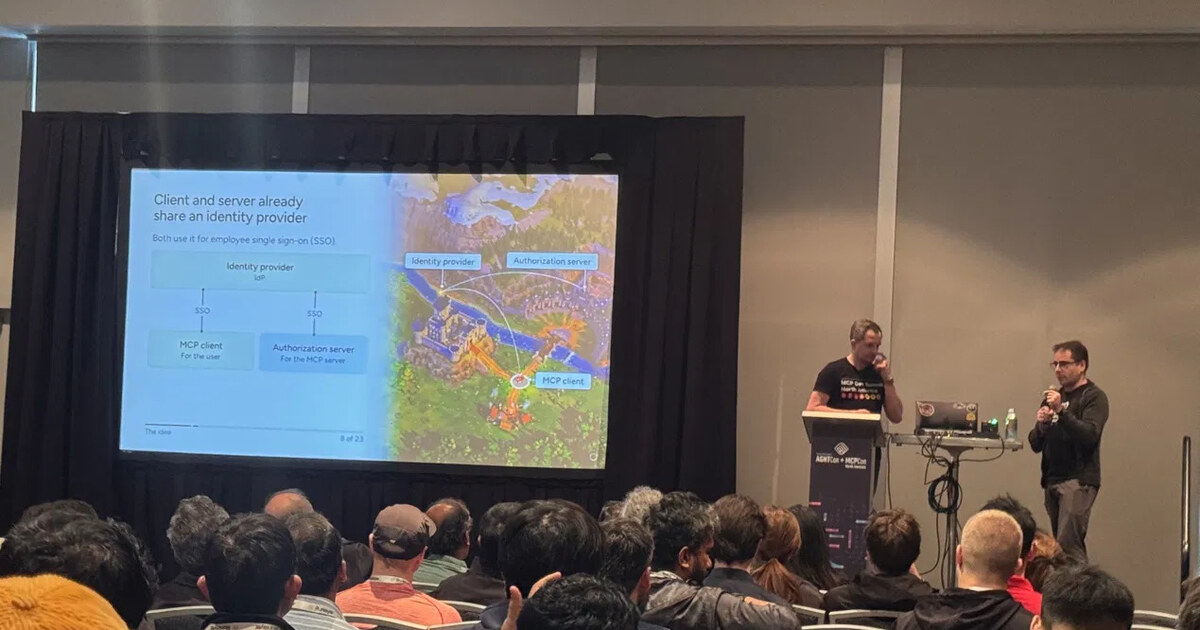
At AGNTCon + MCPCon North America 2026, the Agentic AI Foundation added OpenSandbox, Open Responses, Agent Skills, and OpenEnv, reaching ten projects in its first year. Keynotes from Anthropic, OpenAI, Google, and UC Berkeley focused on MCP in production, security, and agents with their own identities.
By Andrew HoblitzellOpenTofu 1.13 Lets Module Authors Reduce Unknown Values at Plan Time

OpenTofu 1.13 adds convert and assume... functions that let module authors give the planner type and value hints for unknown values, so more expressions resolve during tofu plan. If a value unknown during planning later violates a guarantee, OpenTofu reports an error during apply.
By Mark SilvesterDigitalOcean Launches Learning and Data Services to Enable Self-Improving AI Agents
DigitalOcean has announced the public preview of Learning Services and Agent Data Services, enabling developers to build, evaluate, and continuously improve AI agents within a unified, AI-native, cloud platform.
By Sergio De SimoneProduction AI and Engineering Team Design: InfoQ’s November Certification Cohorts
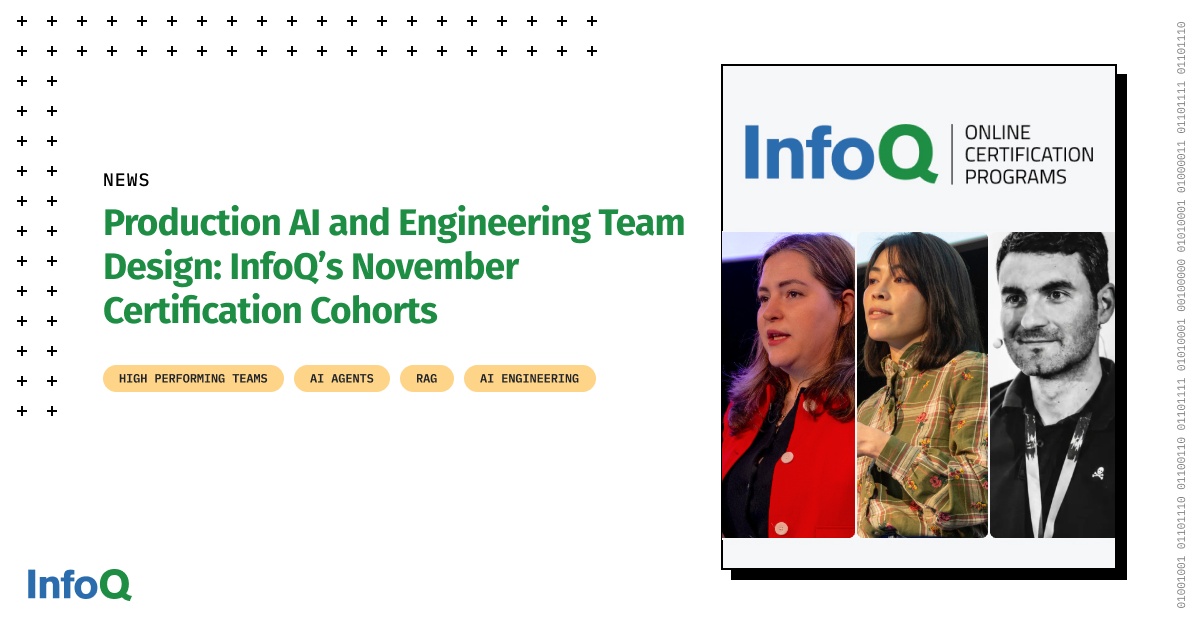
A preview of three November InfoQ online certification cohorts covering production AI systems, retrieval and agent design, engineering team flow, AI roles, and measurement, facilitated by Adi Polak, Lan Chu, and Olimpiu Pop.
By Artenisa ChatziouJava News Roundup: JDK 28 Schedule, Oracle CPUs, eMudhra Certs, Apache POI, WildFly, Azul, BellSoft
This week's Java roundup for October 19th, 2026, features news highlighting: the proposed release schedule for JDK 28; the eMudhra Intermediate CA certificates breach; the October 2026 Critical Patch Update; Azul and BellSoft CPUs; GA releases of WildFly 42 and Apache POI 6.0; the beta release of Open Liberty 26.0.0.11; and maintenance releases of Micronaut and JobRunr.
By Michael Redlich
© 2026 Created by Michael Levin.
Powered by


You need to be a member of Codetown to add comments!
Join Codetown