Codetown
Codetown ::: a software developer's community
Google Donates WindowBuilder Pro and CodePro AnalytiX to Eclipse
Following on from Google's acquisition of Instantiations and their relaunch of WindowBuilder products, Google has today announced that they are donating WindowBuilder and CodePro Profiler to Eclipse.org. A FAQ on the transition is available.
Google has long been a supporter of Eclipse, but the purchase of Instantiations was driven by GWT Designer, the drag-and-drop user interface builder for GWT applications. Since the GWT, Swing and SWT Designer was built on the same foundation, releasing all of them is consistent...
Comment
Happy 10th year, JCertif!
Notes
Welcome to Codetown!
 Codetown is a social network. It's got blogs, forums, groups, personal pages and more! You might think of Codetown as a funky camper van with lots of compartments for your stuff and a great multimedia system, too! Best of all, Codetown has room for all of your friends.
Created by Michael Levin Dec 18, 2008 at 6:56pm. Last updated by Michael Levin May 4, 2018.
Looking for Jobs or Staff?
Check out the Codetown Jobs group.
InfoQ Reading List
Podcast: Simulation Can Tell You What Your Agents are Actually Doing: A Conversation with Zhou Yu

Michael Stiefel spoke to Zhou Yu about using dynamic simulations to evaluate AI agents. One particular focus was conversational agents where actions depend on prior responses, and the non-deterministic nation of LLMs means you cannot rely on static, reference-based benchmarks. You need to test them using dynamic simulations that incorporate different personas, goals, and corner cases.
By Zhou YuQCon San Francisco 2026: The Harness Is the New Operating System
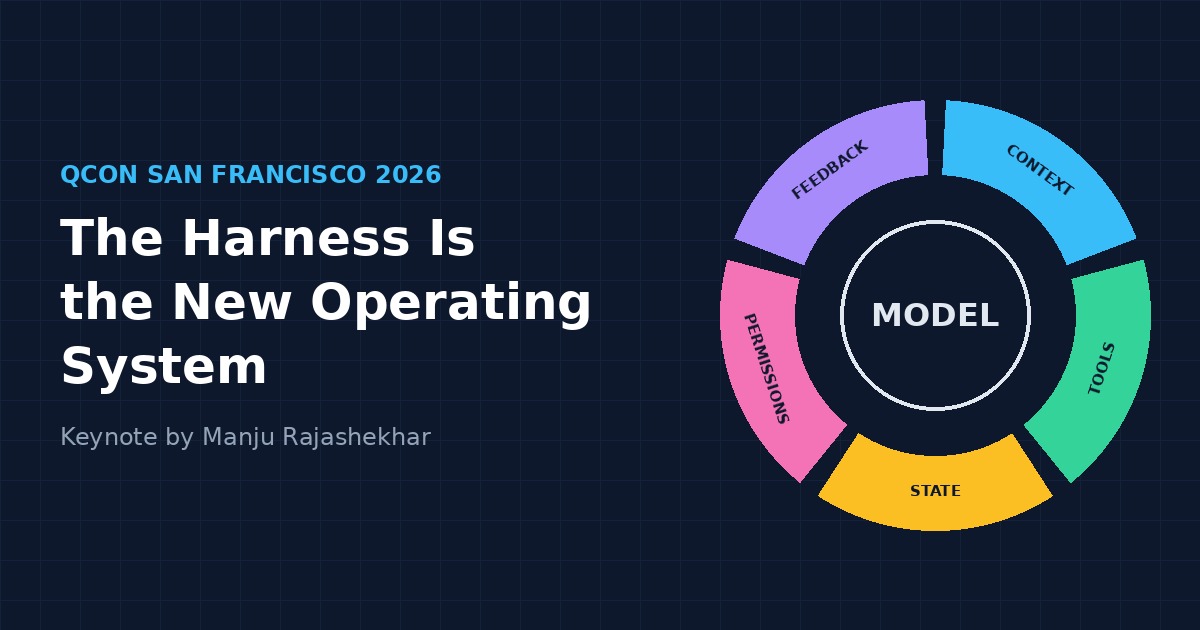
At QCon San Francisco 2026, Mad Labs founder and CEO Manju Rajashekhar opened the conference arguing that the harness around an AI model, rather than the model itself, decides what an agent can do and how safely it does it. The keynote mapped the parts of a harness, including context, tools, state, permissions and feedback loops, onto jobs that operating systems already perform.
By Andrew HoblitzellPostgreSQL 19 Released with Online Table Repacking and Query Planning Controls
The PostgreSQL Global Development Group released PostgreSQL 19, introducing changes to database maintenance, query planning, replication, and application development. The release focuses on reducing administrative overhead and improving performance, with new tools for reorganizing tables without downtime and controlling query plans.
By Robert KrzaczyńskiClaude Code Has Been Leaking Secrets through its "Don't Ask Again" Feature

Agentic security firm Apiiro found that Claude Code has been exposing secrets in public repositories due to how it stores them in local file on developers' machines to implement "Don't Ask Again". The company identified 1,122 secrets in claude/settings.local.json files and another 1,160 in git history, in the shared settings.json, and in agent chat transcripts stored in repos.
By Sergio De SimoneGoogle Announces Agent Compute Engine for Secure AI Agent Execution

Google recently announced Agent Compute Engine, a managed service that runs AI agents in isolated microVMs, with checkpointing capabilities to suspend and resume execution environments. The design keeps credentials, API keys, and OAuth refresh tokens outside the agent sandbox, using an external Agent Gateway to authenticate requests and inject the required secrets.
By Renato Losio
© 2026 Created by Michael Levin.
Powered by


You need to be a member of Codetown to add comments!
Join Codetown