Codetown
Codetown ::: a software developer's community
Call for Papers - M4D 2014 - April 8-9, Dakar, Senegal
Please find below the Call For Papers and information about the 4th International Conference on Mobile Communication for Development http://m4d2014.net. It is coming to Dakar in 2014!
Best,
Dr. Christelle Scharff for the conference committee
--[Sorry for multiple copies of the same message. Please forward to people who may be interested in submitting a paper or attending. The submission deadline is Oct. 1st.]Welcome to M4D2014
The 4th International Conference on Mobile Communication for Development (M4D)http://m4d2014.net
Dakar, Senegal, 8-9 April 2014
University Cheikh Anta Diop (UCAD)in co-operation with HumanIT, Karlstad University
2nd call M4D2014We are happy to announce two exiting keynotes at the M4D2014 conference. Professor Laura Stark from University of Jyväskylä in Finland who will talk about ethnographic approaches to mobile use among the very poor. Our second keynote is Anne Shongwe, founder and CEO of Afroes Transformational Multi-Media & Consulting. Anne has worked with several governments across Africa and South-East Asia as well as with UN, Bill and Melinda Gates foundations and the Nelson Mandela Childrens fund to mention a few.
We are also happy to announce that we are going to organize workshop for PhD students attending the conference with among others the two keynotes, Jonathan Donner from Microsoft Research and Rich Ling from IT University Copenhagen and Telenor research. A separate call will follow this autumn.
M4D2014 aims to provide a forum for researchers, practitioners and all those with interests in the use, evaluation, and theorizing of Mobile Communication for Development. M4D2014 will combine two days of plenary parallel paper sessions, panel sessions, short presentations, posters and workshops.
This conference is the fourth in the M4D biennial series following the inaugural conference in Karlstad, Sweden in 2008. The 2nd conference was in Kampala, Uganda in 2010 and the 3rd in New Delhi, India in 2012.
How to Participate?
M4D2014 welcomes participants from academia, industry, NGOs, development agencies, and governmental and international organizations.
If you want to submit a paper, there are two different options. Research papers (8-12 pages including references) will be peer reviewed and evaluated based on theory craftsmanship and analytical rigor. Articles considering critical approaches and theoretical development will be prioritized. The practitioner’s track is open to practitioners to present their experiences, cases and policies (4-5 pages). These contributions do not have to be guided by academic theory and critical analysis. All accepted papers will be published in the proceedings and allocated a presentation slot.
Presenting with Posters, in Short Track or Parallel Sessions?
Accepted papers with best reviews will be allocated longer presentation slots in parallel sessions. The other accepted papers will be allocated shorter presentation slots in short track sessions that will be followed by poster sessions. Accepted paper presenters should thus be prepared to bring posters with them. Poster size max. 80x120 cm. Roll-ups are also allowed.
You can also participate by organizing a workshop. Workshops submissions for proceedings (2 pages) must contain: title, organizers with affiliation, participants, motivation and objectives. Finally, there is also the possibility to only submit a poster or a demo (1-page extended abstract).
We are particularly interested in (but not limited to):
mLearning
mLivelihood
mAgriculture
mHealth
mParticipation
mGovernance
mInnovation
mDemocracyInclusion of accepted papers/posters/demos/workshops in conference proceedings is conditioned on payment of registration fee prior to registration deadline. Conference proceeding will be published in the Karlstad University Studies Series, as well as on the websites of the University Cheikh Anta Diop and the Centre for HumanIT, Karlstad.
The template and more submission information are available here: www.m4d2014.net and questions can be sent to m4d2014@gmail.com.
Important Dates:
Paper submission deadline: 1 October 2013
Acceptance note papers: 15 January 2014
Final papers due and registration deadline for presenting authors: 15 Feb 2014
Poster/Demo/ workshop submission deadline: 1 February 2014
Acceptance note Posters/Demos/ workshops 15 February 2014
Registration deadline for participants without presentations 1 April 2014
Registration and Fees:The registration will open during autumn 2013, see http://www.m4d2014.net
Conference fee will be 150€ with a reduced fee of 110€ for Master and PhD students. Participants salaried from a developing country are entitled to a 30% discount (105€ and 77€ for PhD and Master Students).
Conference fee includes access to conference venue, presentations, workshops and demonstrations, keynote speakers, one copy of the proceedings, lunches, refreshments and receptions throughout the conference, conference dinner and social events.
Participation Grants:
IPID will sponsor participation for selected members given that there is an accepted paper and based on the reviews as well as on where the student is based (developing countries and Sweden are prioritized). For questions regarding these scholarships contact IPID at info@ipid.se
We hope to arrange travel grants for participants from developing countries that will cover registration fee and a maximum of 500€ for flight tickets and accommodation. Other costs will not be covered for.
Interested in Reviewing?
Please contact m4d2014@gmail.com and make known areas of interest and level of expertise and how many papers/short papers you are interested in reviewing. Due mention will be made in the proceedings.
Interested in Sponsoring?
We are happy to receive funding for travel grants, social events, lunches, refreshments, conference proceedings, etc. Due mention will be made at the occasion, on the website, in the conference program, and in the conference proceedings. Please contact m4d2014@gmail.com for more details.
Conference Committee:
General Chair: Ibrahim Niang (UCAD, Senegal
Local Organizing Chair: Christelle Sharff (Pace University, USA)
Co-chair: Johan Hellström (Stockholm University, Sweden)
Co-chair: Babacar Ngom (UCAD, Senegal
Co-chair: Jean Marie Preira (ESMT, Senegal)
Co-chair: Jakob Svensson (HumanIT, Karlstad University, Sweden)
Co-chair: Caroline Wamala (HumanIT, Karlstad University, Sweden)---
Dr. Christelle ScharffPace UniversitySeidenberg School of Computer Science and Information Systems
Comment
Happy 10th year, JCertif!
Notes
Welcome to Codetown!
 Codetown is a social network. It's got blogs, forums, groups, personal pages and more! You might think of Codetown as a funky camper van with lots of compartments for your stuff and a great multimedia system, too! Best of all, Codetown has room for all of your friends.
Created by Michael Levin Dec 18, 2008 at 6:56pm. Last updated by Michael Levin May 4, 2018.
Looking for Jobs or Staff?
Check out the Codetown Jobs group.
InfoQ Reading List
Pinterest Uses Event Time Watermarks to Finalize Petabyte Scale Data Partitions
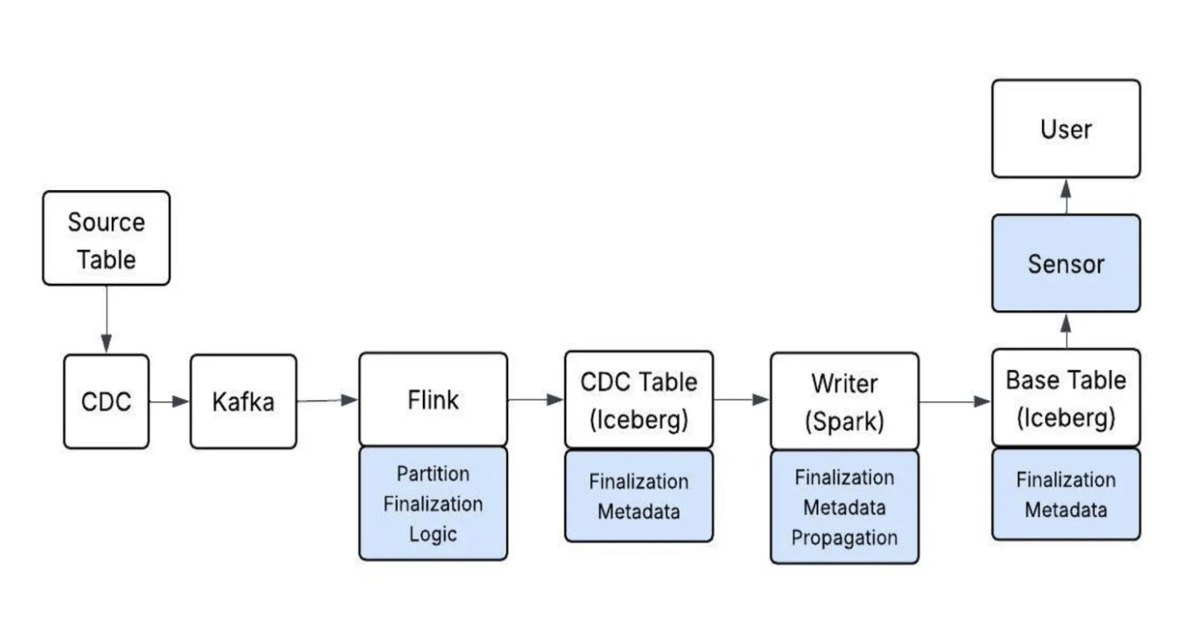
Pinterest has introduced event time-based partition finalization for its database ingestion framework. The mechanism uses Apache Flink to track event time and Apache Iceberg metadata to publish a non-regressing watermark, helping downstream jobs determine when continuously ingested CDC data is sufficiently complete for processing.
By Leela KumiliJEP 543 Finalizes Structured Concurrency in JDK 28, Ending Seven Preview Rounds

JDK 28 finalizes structured concurrency through JEP 543, with no API changes from JDK 27. Teams on JDK 27 only need to drop --enable-preview and recompile. Code written for JDK 25 or 26 must adapt to the R_X exception type parameter, ExecutionException wrapping, and the abstract timeout() joiner callback.
By A N M Bazlur RahmanPodcast: The Future of Web Apps: Will AI Agents Generate UIs on the Fly?

Rachel Lee Nabors, former React core team member, dives into the architecture and philosophy behind local-first applications, exploring how small language models (SLMs) running directly on-device can deliver privacy-focused, low-latency, and cost-effective alternatives to cloud-hosted LLM wrappers.
By Rachel Lee NaborsArticle: From Microservices to Agents: the Next Evolution of Distributed Systems

The article examines the transition from microservices to agentic AI architecture in distributed systems. Microservices allow for functional decomposition, while agentic systems focus on decision decomposition. This shift introduces new complexities in observability, reliability, and system design, highlighting the need for updated architectural patterns and practices.
By Mallika RaoEmbeddingGemma 2 Expands beyond Text to Support Code, Images, Video, and Audio

Based on Gemma 4 and released under the Apache 2.0 license, Google's EmbeddingGemma 2 is a compact, open-weight, multimodal embedding model designed to make semantic search and retrieval-augmented generation (RAG) more efficient while optimizing performance for on-device deployment.
By Sergio De Simone
© 2026 Created by Michael Levin.
Powered by


You need to be a member of Codetown to add comments!
Join Codetown