Codetown
Codetown ::: a software developer's community
OrlandoJUG on Maven Jan, '10
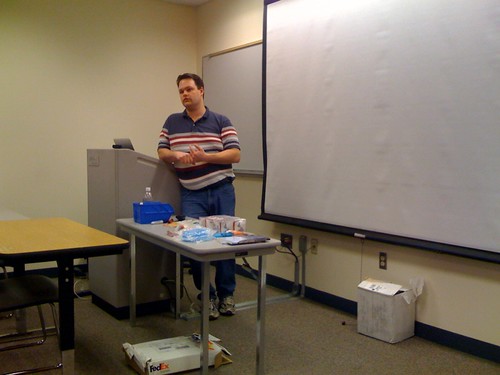
Brian Fox gave a presentation on Maven this month at the OrlandoJUG.
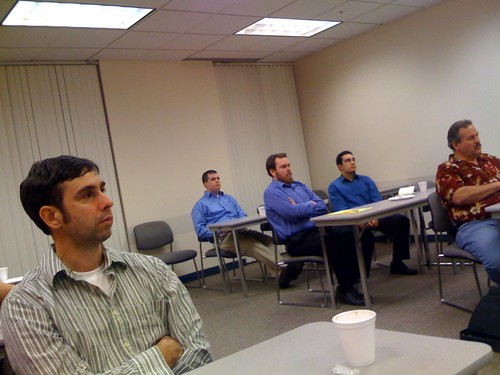
Maven has matured into a more user friendly tool, according to Brian. His company, Sonatype, supports Maven in the commercial world. They've published books as well.
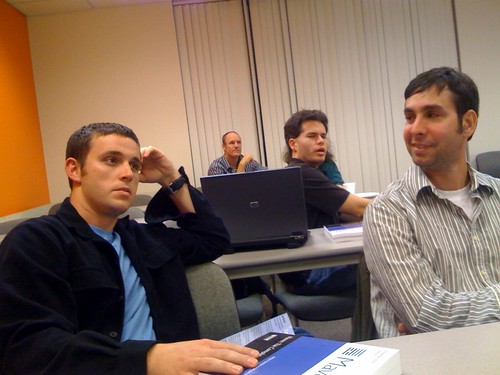
I must admit, although the talk was informative, I didn't walk away feeling like I could sit down and start using Maven based on what I learned. This was an overview of Maven's features, not a hands on workshop.
I will say, however, that Maven has wide acceptance as a powerful, open source tool to help in building projects that use multiple components. Last time I used it, I had a very difficult time getting it configured. It just wasn't user friendly. I've learned over the years now that it's often not me, but fragile tools and documentation that cause failures under time contraints.
Yucch!
Well, now we have a set of books on Maven and Sonatype's support to help us along.
I'm ready to give it another shot when the occasion arises.
After the meeting, we chatted about cellphones. David Harris showed us his new Android phone. A spirited conversation ensued. A few people have commented that Java folk should show more discernment in their choice of cellphone, namely iPhones. We talked about iPhone being a closed box. How Apple does everything many folks hate about Microsoft but is forgiven because...because they have "good products". Provocative? You bet. That assertion was countered with a comment that "there's nothing wrong with making money" referring to the two camps that sometimes don't see eye to eye: open source and commercial apps.
We had some good pizza, cold drinks and stimulating conversation. Like the sound of it? Come on out to next month's OrlandoJUG, or GatorJUG...or your local user group meeting. We had folks from local software firms I had never heard of, who have been in town as long as I have. What's cool about that? Well, it's not just a hobby! We like work. Work is good. The trick is to find 1) work that's 2) interesting and 3) pays a fair wage. Who ya gonna call? I prefer to throw the party rather than wait around to be invited. You, too can be the master of your own destiny. Get up, get out and meet some folks. Share what you know and learn some stuff while filling your belly with good food and have a good time!
Comment
-
Comment by Zemian Deng on January 31, 2010 at 1:13pm
-
Hey Mike,
Sorry to hear you are not a fan of Maven yet. Well, I don't think you are the only one. This link got mentioned in javaposses.com last broadcast. http://kent.spillner.org/blog/work/2009/11/14/java-build-tools.html. Doesn't sound like that guy like Maven at all. :-P
There few things in Maven that bugs me too. Like its verboseness in xml config, the many defaults values in for frequently used plugins are outdated. Like compiler target source is not default to 1.5 or higher, default java source is not UTF-8, default junit comes with a useless xml out of system defaults. I have to change these on most of my project since they seems not up-to-date. But these seems to be minor things. It's configurable and I just change the values and move on.
Having said that, I think Maven is a wonderful tool. Like any piece of software, we ought to use it as it was designed to take a full advantage of it. I have used for many projects and it solved most of my need as a build tool. Sonatype's repository manager is pretty awesome. It has a simple user interface and easy to manage. It's fantastic to setup as a internal repository in a company.
To gain more confidence, you should check out how few of larger open source projects are using Maven. Obviously Apache is using maven like crazy :-P. But hey Apache produce some great some software, and maven helps them get there. Check out JBoss, originally use Ant for everything, and now they switched to entirely Maven based build starting jboss6. MuleESB and Atlassin JIRA are couple of my favorite and successfully software that I know they use Maven heavily for their dev.
Happy 10th year, JCertif!
Notes
Welcome to Codetown!
 Codetown is a social network. It's got blogs, forums, groups, personal pages and more! You might think of Codetown as a funky camper van with lots of compartments for your stuff and a great multimedia system, too! Best of all, Codetown has room for all of your friends.
Created by Michael Levin Dec 18, 2008 at 6:56pm. Last updated by Michael Levin May 4, 2018.
Looking for Jobs or Staff?
Check out the Codetown Jobs group.
InfoQ Reading List
Bintrail: MySQL Time-Travel Queries Using Indexed Binlogs

Bintrail is a recently introduced layer that brings point-in-time queries and row-history lookups to MySQL, the only major relational database lacking native temporal querying. Using indexed binlogs behind ProxySQL and without modifying MySQL or application code, Bintrail supports querying data as of a past timestamp and reviewing change history, primarily for recovery and audit scenarios.
By Renato LosioSix Sessions at QCon AI Boston 2026 That Take Productionizing AI Seriously
QCon AI Boston 2026 is close to selling out. Six sessions where speakers engage directly with the gap between AI working in a demo and AI working in production.
By Artenisa ChatziouPresentation: The Ironies of A^2 I^2

J. Paul Reed discusses the "ironies of automation" - a 40 years-old concept now amplified by AI. He explains how advanced systems often make the human operator more crucial, not less, while simultaneously degrading the skills needed to intervene. Sharing real-world stories of "AI-fueled" incidents, he shares why over-reliance on AI can double recovery times and how to maintain resilience.
By J. Paul ReedHow Platform Engineering Using Golden Bricks Can Enable Fast and Smooth Delivery

Platform engineering should have a product focus, as developers are customers; they must provide composable, self-service capabilities, golden bricks rather than rigid golden paths, so teams can move quickly while maintaining consistency. Success is measured through adoption, developer experience, and business outcomes such as deployment frequency and change failure rate.
By Ben LindersWith Android CLI, Google is Making the Android Toolchain Agent-Friendly

Google introduced new Android development tools that enable building apps up to 3x faster by using AI agents, including a redesigned Android command-line interface (CLI), structured skills", and an integrated knowledge base. These tools are designed to support agent-driven workflows and are compatible with third-party agents such as Claude Code and Codex, in addition to Google Gemini.
By Sergio De Simone
© 2026 Created by Michael Levin.
Powered by


You need to be a member of Codetown to add comments!
Join Codetown