Codetown
Codetown ::: a software developer's community
Happy 10th year, JCertif!
Notes
Welcome to Codetown!
 Codetown is a social network. It's got blogs, forums, groups, personal pages and more! You might think of Codetown as a funky camper van with lots of compartments for your stuff and a great multimedia system, too! Best of all, Codetown has room for all of your friends.
When you create a profile for yourself you get a personal page automatically. That's where you can be creative and do your own thing. People who want to get to know you will click on your name or picture and…
ContinueCreated by Michael Levin Dec 18, 2008 at 6:56pm. Last updated by Michael Levin May 4, 2018.
Looking for Jobs or Staff?
Check out the Codetown Jobs group.
InfoQ Reading List
Grafana Tempo 3.1 Adds Query-Based Trace Redaction and Sampling-Aware TraceQL Metrics

Grafana Labs has released Tempo 3.1, the first minor update to the 3.0 architecture. It adds TLS and additional SASL mechanisms to the Kafka client, lets operators redact traces with a TraceQL query instead of a list of trace IDs, and introduces an experimental query-time hint that corrects TraceQL metrics for sampled data.
By Claudio MasoloArticle: Server-Side DPoP and Token Exchange in Spring Security 7

Spring Authorization Server now lives inside Spring Security 7 under the same Maven coordinates, so the upgrade is a version bump. This server-side guide covers enabling DPoP and RFC 8693 Token Exchange, explains why 7.1 apps can silently stop enforcing DPoP until they call .dPoP(), and shows how to combine both into narrowed, sender-constrained tokens for service-to-service and agentic calls.
By Dhruv AgnihotriMeta Extends Confidential Computing to AI Glasses with Private Processing
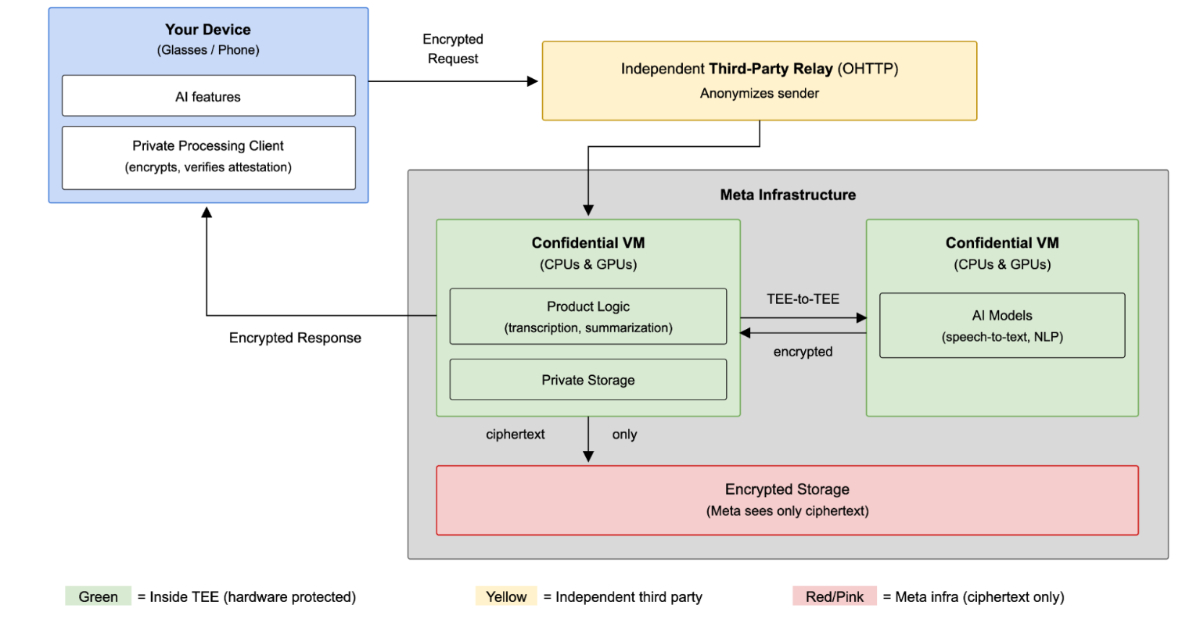
Meta has extended Private Processing to AI glasses, using confidential VMs, trusted execution environments, remote attestation, anonymous credentials, OHTTP routing, and TEE-based storage to process AI workloads and persistent user context in the cloud.
By Leela KumiliPresentation: How to Find Resilience Bugs in Systems that Don't Exist

Hillel Wayne discusses how formal methods principles - such as property strength, state-space verification, and environment assumptions - help software engineers uncover critical architectural bugs early. He shares practical mental models like "adversarial non-determinism" to reason about concurrency, edge cases, and distributed system failures without needing complex mathematical tools.
By Hillel WayneGoogle Antigravity SDK Adds Local Model Support for Greater Token Efficiency and Code Privacy

Google has introduced support for local models in the Antigravity SDK, enabling developers to build and execute agentic workflows directly on their own machines, while retaining the flexibility to mix in cloud-based models for higher-level tasks. This approach gives developers greater control over data privacy, inference costs, network dependencies, and computational workload distribution.
By Sergio De Simone
© 2026 Created by Michael Levin.
Powered by


You need to be a member of Codetown to add comments!
Join Codetown