Codetown
Codetown ::: a software developer's community
Coroutine-First Android Architecture w/ Rick Busarow
Chicago Kotlin User Group x Android Listeners
Hosted at GrubHub, July 17
Coroutines are the new hot stuff, and right now they’re being added to lots of libraries. But what if you don’t want to use an alpha01 in production code? What can coroutines do on their own, right now? In this talk, we’ll discuss the power behind structured concurrency and how we can use it to make our entire stack lifecycle-aware. We’ll look at examples of how to turn any callback or long-running code into a coroutine, and we’ll go over when and how to use Channels to handle hot streams of data without leaking. Finally, and most importantly, we’ll see how we can use these tools to inform our application architecture, so that we can quickly write maintainable and testable features. Thanks to GrubHub for hosting!
Views: 80
Happy 10th year, JCertif!
Notes
Welcome to Codetown!
 Codetown is a social network. It's got blogs, forums, groups, personal pages and more! You might think of Codetown as a funky camper van with lots of compartments for your stuff and a great multimedia system, too! Best of all, Codetown has room for all of your friends.
Created by Michael Levin Dec 18, 2008 at 6:56pm. Last updated by Michael Levin May 4, 2018.
Looking for Jobs or Staff?
Check out the Codetown Jobs group.
InfoQ Reading List
Transformers v5 Introduces a More Modular and Interoperable Core

Hugging Face has released the first candidate for Transformers v5, marking a significant evolution from v4 five years ago. The library has grown from a specialized model toolkit to a critical resource in AI development, achieving over three million installations daily and more than 1.2 billion total installs.
By Robert KrzaczyńskiMeta's Optimization Platform Ax 1.0 Streamlines LLM and System Optimization

Now stable, Ax is an open-source platform from Meta designed to help researchers and engineers apply machine learning to complex, resource-intensive experimentation. Over the past several years, Meta has used Ax to improve AI models, accelerate machine learning research, tune production infrastructure, and more.
By Sergio De SimoneLyft Rearchitects ML Platform with Hybrid AWS SageMaker-Kubernetes Approach
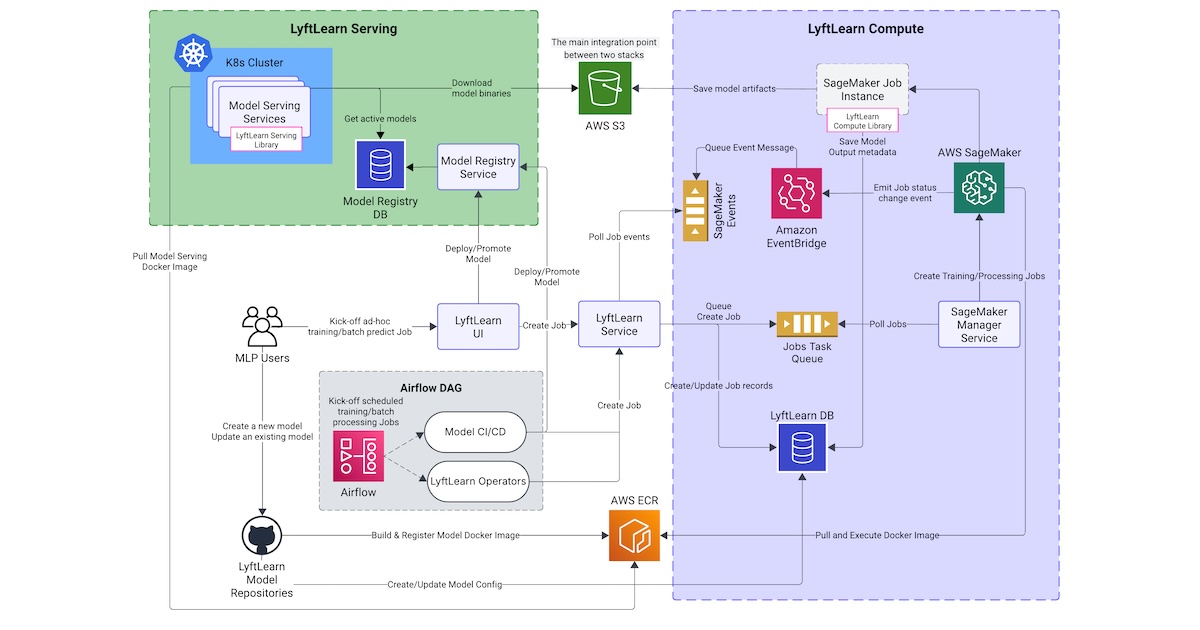
Lyft has rearchitected its machine learning platform LyftLearn into a hybrid system, moving offline workloads to AWS SageMaker while retaining Kubernetes for online model serving. Its decision to choose managed services where operational complexity was highest, while maintaining custom infrastructure where control mattered most, offers a pragmatic alternative to unified platform strategies.
By Eran StillerAWS Transform Custom Tackles Technical Debt

AWS Transform Custom revolutionizes code modernization with AI-driven, out-of-the-box transformations for Java, Node.js, and Python. This enterprise-focused tool accelerates application upgrades by up to 5x while learning from organizational nuances to deliver high-quality, repeatable transformations.
By Steef-Jan WiggersArticle: Trustworthy Productivity: Securing AI Accelerated Development

Autonomous AI agents amplify productivity but can cause severe damage without safeguards. Defend the ReAct loop—context, reasoning, and tools—through provenance gates, planner-critic separation, scoped credentials, sandboxed code, and STRIDE/MAESTRO threat modeling. With robust logging, bounded autonomy, and red-teaming, agents can deliver trustworthy productivity while minimizing risk.
By Sriram Madapusi VasudevanSwitch to the Mobile Optimized View
© 2025 Created by Michael Levin.
Powered by

