Codetown
Codetown ::: a software developer's community
Coroutine-First Android Architecture w/ Rick Busarow
Chicago Kotlin User Group x Android Listeners
Hosted at GrubHub, July 17
Coroutines are the new hot stuff, and right now they’re being added to lots of libraries. But what if you don’t want to use an alpha01 in production code? What can coroutines do on their own, right now? In this talk, we’ll discuss the power behind structured concurrency and how we can use it to make our entire stack lifecycle-aware. We’ll look at examples of how to turn any callback or long-running code into a coroutine, and we’ll go over when and how to use Channels to handle hot streams of data without leaking. Finally, and most importantly, we’ll see how we can use these tools to inform our application architecture, so that we can quickly write maintainable and testable features. Thanks to GrubHub for hosting!
Views: 92
Happy 10th year, JCertif!
Notes
Welcome to Codetown!
 Codetown is a social network. It's got blogs, forums, groups, personal pages and more! You might think of Codetown as a funky camper van with lots of compartments for your stuff and a great multimedia system, too! Best of all, Codetown has room for all of your friends.
Created by Michael Levin Dec 18, 2008 at 6:56pm. Last updated by Michael Levin May 4, 2018.
Looking for Jobs or Staff?
Check out the Codetown Jobs group.
InfoQ Reading List
HeroUI v3 Lands as a Ground-Up Rewrite for React and React Native, Built on Tailwind CSS v4

HeroUI v3 is a redesigned React component library, previously NextUI, offering over 75 components, including 21 new ones, and a new React Native library with 37 components. Built on React Aria and Tailwind CSS v4, it emphasizes accessibility and customization. The library has experienced many updates since its release, and migration from the previous version is necessary.
By Daniel CurtisPresentation: The Infrastructure Challenge Behind Production AI

The panelists explain the realities of running AI systems reliably at scale. While building models is solved, maintaining production databases under constant pressure is not. They discuss the emerging architectural decisions separating teams that scale gracefully from those facing catastrophic outages, and what engineering leaders must rethink today.
By Simerus Mahesh, Alex Infanzon, Meryem Arik, Luca Bianchi, Renato LosioPresentation: Trustworthy Productivity: Securing AI-Accelerated Development
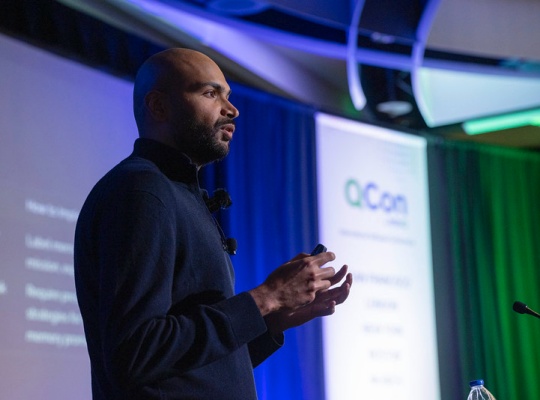
Sriram Madapusi Vasudevan discusses industry-converging patterns for securing autonomous AI agents in production. He explains the critical vulnerabilities hidden inside the ReAct loop across context, reasoning, and tool execution. He shares how to mitigate risks like memory poisoning and rogue tool execution using defense-in-depth strategies, LLM-as-a-judge critics, and MAESTRO threat modeling.
By Sriram Madapusi VasudevanElastic Open-Sources Atlas Agent Memory Based on Cognitive Science

Elastic open-sourced Atlas, a system built on Elasticsearch that maintains three categories of memory for agents. Atlas integrates with agents via MCP and maintains per-user isolation of memories. When evaluated on question-answering capability, it scored 0.89 Recall@10.
By Anthony AlfordMicrosoft Brings AI-Powered Vulnerability Remediation to Azure DevOps with Copilot Autofix

Microsoft has announced the limited public preview of Copilot Autofix for GitHub Advanced Security for Azure DevOps, extending AI-powered vulnerability remediation to teams using Azure Repos.
By Craig Risi
© 2026 Created by Michael Levin.
Powered by

