Codetown
Codetown ::: a software developer's community
My Friends (1)
Happy 10th year, JCertif!
Notes
Welcome to Codetown!
 Codetown is a social network. It's got blogs, forums, groups, personal pages and more! You might think of Codetown as a funky camper van with lots of compartments for your stuff and a great multimedia system, too! Best of all, Codetown has room for all of your friends.
Created by Michael Levin Dec 18, 2008 at 6:56pm. Last updated by Michael Levin May 4, 2018.
Looking for Jobs or Staff?
Check out the Codetown Jobs group.
InfoQ Reading List
How Google Traced GKE API Timeouts to a Linux Kernel TCP Bug

Google recently detailed how three interacting bugs across Google Kubernetes Engine (GKE), Private Service Connect, and the Linux kernel caused intermittent Kubernetes API connectivity failures, blocking around 800 developers from deploying to production.
By Renato LosioMeta TLX, a Native GPU Compiler Extension Supporting Advanced Hardware Capabilities

Meta developed Triton Low-Level Extensions (TLX), designed to bridge the gap between high-level GPU programming abstractions and the low-level execution control required to fully exploit modern GPU architectures.
By Sergio De SimoneUber Cuts Translation Cache Memory by up to 90% While Keeping P99 Latency Below 1 MS

Uber redesigned its Go-based translation cache to reduce its initial memory footprint by more than 90% while maintaining a cache hit rate above 99.9% and p99 disk-backed cache miss latency below 100 microseconds. The hybrid architecture combines in-memory keys and frequently accessed values with disk-backed storage, reducing garbage-collection overhead and memory consumption.
By Leela KumiliGoogle Donates Agent Substrate and gVisor to the CNCF to Secure AI Agents at Scale

Google has announced it is donating Agent Substrate and gVisor to the Cloud Native Computing Foundation (CNCF), placing two important components of its AI agent infrastructure under vendor-neutral open-source governance.
By Craig RisiPresentation: Modernising Retail at Scale: Architecting a Cloud‑to‑Edge Platform for a Global Enterprise
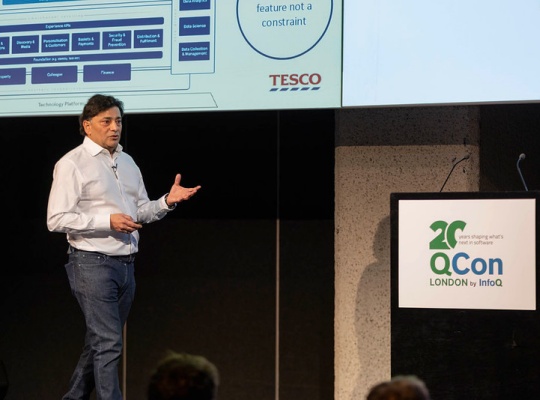
Jayesh Bhayani discusses Tesco’s decade-long enterprise transformation from fragmented legacy systems to a unified cloud-edge platform. He explains how aligning system, talent, and process modernizations allowed Tesco to scale mission-critical retail operations to millions of customers, while sharing practical lessons on build vs. buy, cloud cost management, and preparing for agentic commerce.
By Jayesh Bhayani
© 2026 Created by Michael Levin.
Powered by

