Codetown
Codetown ::: a software developer's community
Groovy and Grails biggest problem...
Views: 202
Replies to This Discussion
-
Permalink Reply by Zemian Deng on
-
Robert Dempsey said:What I am looking for is performance comparisons of Groovy/Grails with other frameworks combined with Java such as Spring.
Hello Robert, Have you explored Scala programming? It gives you the short and flexibility of Groovy like expressiveness, but yet has good performance as close as to Java itself! Scala is static typed instead of dynamic though. Check out other post I made few days ago under Other JVM Group on this site see if you like it.
-Z -
-
Permalink Reply by Jim Moore on
-
What needs to be performant and why? Things like Twitter are built on a notoriously slow platform (ie, Ruby on Rails) but it's plenty fast enough.
Grails is obviously slower than Spring MVC since it's built on old versions of Spring MVC and Spring WebFlow. Does it matter? For the vast majority of web sites the answer is trivially simple: No.
Scala is faster and slower than Java depending on what you're doing. Groovy is slower than both, but who cares? It's more than fast enough for what it's used for.
If you really need speed, write in assembly code. If you think that's not reasonable, then ask yourself why you're willing to sacrifice that speed to be able to write in Java. Then apply the same reasoning to why you would program in something like Grails.
Note that I'm not saying that you should use Grails, just that looking at performance without solid reasons *why* is well beyond foolish. -
-
Permalink Reply by Jackie Gleason on
-
There are some performance issues (For example I have been told my IDE friendly specific typing can cause issues) that make Scala/Java better for some high volume projects. However, for simplicity and readability groovy is a better way to develop, IMHO
Jackie -
-
Permalink Reply by John Thompson on
-
To answer adoption - Grails is becoming more and more mainstream. Sky.com, Wired, and Walmart (specifically mp3.walmart.com) are some notable sites using Grails.
In benchmarking, yes, Grails is slower. But improvements are being made, both to Groovy and Grails itself.
And benchmarks are generally useless in the real world. Every application is different. Bad code, poor database design, poor technology choices, etc are going to have a far greater impact then the language used.
Where performance is an issue, you can always use Java (or Scala). In fact, much of the Grails framework is in Java, not Groovy. It all comes down to using the right tool for the job.
Also - in the age of distributed computing, I need to ask who cares if there is a 20-30% performance penalty. What does it matter if you need to spool up another VM or two in the cloud? -
Happy 10th year, JCertif!
Notes
Welcome to Codetown!
 Codetown is a social network. It's got blogs, forums, groups, personal pages and more! You might think of Codetown as a funky camper van with lots of compartments for your stuff and a great multimedia system, too! Best of all, Codetown has room for all of your friends.
Created by Michael Levin Dec 18, 2008 at 6:56pm. Last updated by Michael Levin May 4, 2018.
Looking for Jobs or Staff?
Check out the Codetown Jobs group.
InfoQ Reading List
Shopify Upgrades Checkout Blocks to Polaris Web Components, Cutting Bundle Sizes up to 85%

Shopify has updated its Checkout Blocks app, transitioning five high-traffic checkout UI extensions to remote-dom using Preact and Polaris web components. The rewrite, which involved moving to TypeScript and a new API version, led to significant reductions in bundle sizes and load times. From October 1, 2026, only the updated versions will be supported.
By Daniel CurtisGithub Migrates Copilot Runtime to Rust with AI-Assisted Rewrite
GitHub migrated more than 800,000 lines of Copilot runtime code from TypeScript and Node.js to Rust in about 14.5 weeks using AI-assisted development. The incremental migration used N-API interoperability, automated testing, human review, and 128 pull requests while continuing to ship releases.
By Leela KumiliCircleCI Makes Machine Runner Orchestrator Generally Available

CircleCI has made its Machine Runner Orchestrator 1.0.0 generally available, providing automated scaling of self-hosted machine runner virtual machines according to CI workload demand.
By Craig RisiPresentation: Ontology‐Driven Observability: Building the E2E Knowledge Graph at Netflix Scale
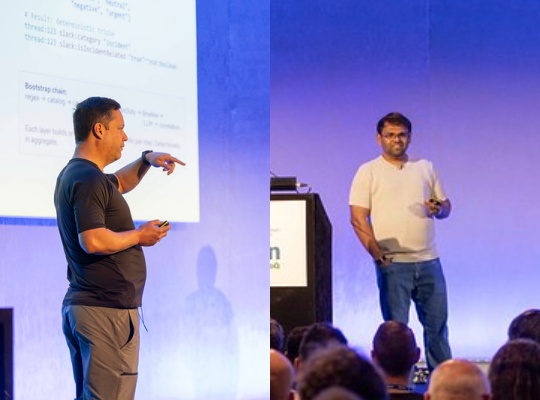
Prasanna Vijayanathan and Renzo Sanchez-Silva share how Netflix tackles observability across 38M events/sec. They discuss replacing reactive monitoring with an AI-driven operational ontology and agentic workflows using Claude and graph databases. They explain how unifying MELT telemetry into queryable knowledge graphs enables automated triaging, root-cause analysis, and self-healing systems.
By Prasanna Vijayanathan, Renzo Sanchez-SilvaOlson and Söderqvist Discuss Valkey’s Evolution and Future Past Caching Use Cases at OSS EU
Valkey is a growing project, launched as a fork of Redis over two years ago, supported by twelve maintainers and nine committee members from various companies. Recent developments include enhanced throughput, improved cluster functionality, and plans for features like synchronous replication and tiered storage. The project also emphasises security and release efficiency through automation.
By Olimpiu Pop
© 2026 Created by Michael Levin.
Powered by

