Codetown
Codetown ::: a software developer's community
Connecting to a database...base de données!
(I'm posting this for Mara, who speaks French and lives in Africa - please give him a hand with his dev question! I translated the question using Babelfish. You can, too.)
Hello! I have only one problem to be able to advance, It is the connection of the iPhone application to a database. I would like to know the most suitable base and the methods of connection. Thank you.
Mara
Hello!
J'ai un seul problème pour pouvoir avancer, c'est la connexion de l'application iPhone à une base de données. Je voudrais savoir la base la plus appropriée et les méthodes de connexion.
Merci, Mara
Views: 73
Replies to This Discussion
-
Permalink Reply by Michael Levin on
-
Here's an update: "J'ai installé le framework de mysql mais aprés avoir compilé mon programme j'obtiens comme erreur: ".objc_class_name_MCPConnection", referenced from:
Qu'est ce fait ça et comment peut on le corriger."
Translated:
"I installed the framework of mysql but after compiling my program I get as error: ". Objc_class_name_MCPConnection", referenced from:
What is it and how can we fix it. " -
-
Permalink Reply by Kevin Collins on
-
I just published my first iPhone App, Party Twacker. This app uses SQLite which is perfect for the iPhone dev environment. Go to www.sqlite.org for more information.
* 300 million copies of Mozilla Firefox.
* 20 million Mac computers, each of which contains multiple copies of SQLite
* 20 million websites run PHP which has SQLite built in. [3] We have no way of estimating what fraction of those sites actively use SQLite, but we think it is a significant fraction.
* 450 million registered Skype users.
* 20 million Symbian smartphones shipped in Q3 2007 [5] Newer versions of the SymbianOS have SQLite built in. It is unclear exactly how many Symbian phones actually contain SQLite, so we will use a single quarter's sales as a lower bound.
* 10 million Solaris 10 installations, all of which require SQLite in order to boot.
* Millions and millions of copies of McAfee anti-virus software all use SQLite internally.
* Millions of iPhones use SQLite
* Millions and millions of other cellphones from manufactures other than Symbian and Apple use SQLite. This has not been publicly acknowledged by the manufactures but it is known to the SQLite developers.
* There are perhaps millions of additional deployments of SQLite that the SQLite developers do not know about. -
Happy 10th year, JCertif!
Notes
Welcome to Codetown!
 Codetown is a social network. It's got blogs, forums, groups, personal pages and more! You might think of Codetown as a funky camper van with lots of compartments for your stuff and a great multimedia system, too! Best of all, Codetown has room for all of your friends.
Created by Michael Levin Dec 18, 2008 at 6:56pm. Last updated by Michael Levin May 4, 2018.
Looking for Jobs or Staff?
Check out the Codetown Jobs group.
InfoQ Reading List
Cycle Introduces EU Control Plane as Sovereignty Debate Continues

Cycle recently introduced a separate EU-based control plane, allowing European customers to keep platform management data and telemetry within Europe. The new offering is designed to improve compliance, operational isolation, and responsiveness for European organizations.
By Renato LosioCloudflare Details Unified Data Platform Where Billing Workloads Account for 53% of Queries
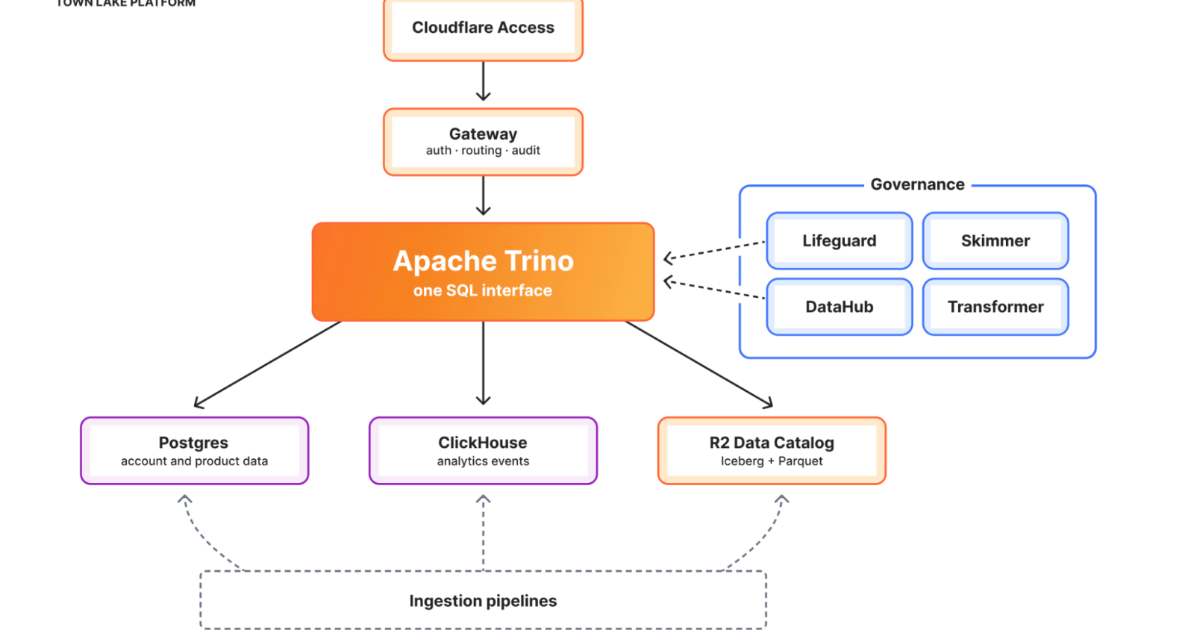
Cloudflare details Town Lake, an internal unified data platform, and Skipper, an AI analytics agent unifying access to operational, billing, security, and business data. The platform processed ~91K billing queries, with billing forming majority usage. Built on a lakehouse architecture using Trino, Iceberg, R2, and DataHub, it enables governed cross-system analytics and natural language access.
By Leela KumiliHardwood Promises High-Speed JVM Apache Parquet Processing with Zero Mandatory Dependencies

Hardwood, the project Gunnar Morling kick-started to improve the handling of Parquet files in Java, reached version 1. Its multi-threaded approach and zero mandatory external dependencies promise a simpler, optimal alternative to the Apache Parquet Java implementation. For now, the library provides a reading via API and a CLI for visualisation; writing support is expected in the upcoming versions.
By Olimpiu PopOpenTelemetry Graduates to CNCF's Highest Maturity Level

The Cloud Native Computing Foundation (CNCF) has announced the graduation of OpenTelemetry, elevating the project to the foundation's highest level of maturity and formally recognizing it as production-ready for enterprise use.
By Craig RisiMini book: Agentic AI Architecture

In this eMag, we try to establish agentic AI architecture as a new type of software architecture that will likely dominate the industry for years to come. The articles, written by industry experts, cover various elements and aspects of agentic AI architecture. We aim to present the latest trends and developments shaping the new type of architecture as it enters the mainstream.
By InfoQ
© 2026 Created by Michael Levin.
Powered by

