Codetown
Codetown ::: a software developer's community
Using scala scripts to check Java jar files
Have you tried to verify that a Class must exists in a lib directory that has few dozens jar files? For example I read from a forum that there is a ServerInfo.properties inside one of tomcat jar, so I run this:
$ scala searchjar.scala ServerInfo /opt/tomcat6/lib /opt/tomcat6/lib/catalina.jar org/apache/catalina/util/ServerInfo.classThe script can walk over one or more directory and search all jar files for you.
/opt/tomcat6/lib/catalina.jar org/apache/catalina/util/ServerInfo.properties
The second thing I do once a while is I want to see the content of a text inside the jar. For the example above, I can run my second script like this:
$ scala displayjar.scala /opt/tomcat6/lib/catalina.jar org/apache/catalina/util/ServerInfo.properties # Licensed to the Apache Software Foundation (ASF) under one or moreYou can even run the displayjar.scala with just a jar file, and it default to print out the Manifest file content.
# contributor license agreements. See the NOTICE file distributed with
# this work for additional information regarding copyright ownership.
# The ASF licenses this file to You under the Apache License, Version 2.0
# (the "License"); you may not use this file except in compliance with
# the License. You may obtain a copy of the License at
#
# http://www.apache.org/licenses/LICENSE-2.0
#
# Unless required by applicable law or agreed to in writing, software
# distributed under the License is distributed on an "AS IS" BASIS,
# WITHOUT WARRANTIES OR CONDITIONS OF ANY KIND, either express or implied.
# See the License for the specific language governing permissions and
# limitations under the License.
server.info=Apache Tomcat/6.0.18
server.number=6.0.18.0
server.built=Jul 22 2008 02:00:36
Hope these scripts are useful to you.
Views: 58
- Attachments:
-
-
 searchjar.scala, 1 KB
 -
displayjar.scala, 1 KB
-
Happy 10th year, JCertif!
Notes
Welcome to Codetown!
 Codetown is a social network. It's got blogs, forums, groups, personal pages and more! You might think of Codetown as a funky camper van with lots of compartments for your stuff and a great multimedia system, too! Best of all, Codetown has room for all of your friends.
Created by Michael Levin Dec 18, 2008 at 6:56pm. Last updated by Michael Levin May 4, 2018.
Looking for Jobs or Staff?
Check out the Codetown Jobs group.
InfoQ Reading List
AWS Introduces Amazon S3 Annotations

AWS recently announced Amazon S3 Annotations, a feature that lets teams attach rich, searchable context such as summaries, classifications, compliance data, or AI-generated insights directly to S3 objects. Annotations can be updated independently of the object and queried across datasets, reducing the need for separate metadata systems.
By Renato LosioClaude Reaches GA on Microsoft Foundry: European Enterprises Cannot Deploy It

Claude models reached GA on Microsoft Foundry with Azure-native billing and governance, but no European data zone exists. Anthropic's own documentation confirms data residency guarantees apply to Bedrock and Vertex AI but not Foundry. European practitioners from banking and healthcare report the offering is unapproved for production.
By Steef-Jan WiggersCycle Introduces EU Control Plane as Sovereignty Debate Continues

Cycle recently introduced a separate EU-based control plane, allowing European customers to keep platform management data and telemetry within Europe. The new offering is designed to improve compliance, operational isolation, and responsiveness for European organizations.
By Renato LosioCloudflare Details Unified Data Platform Where Billing Workloads Account for 53% of Queries
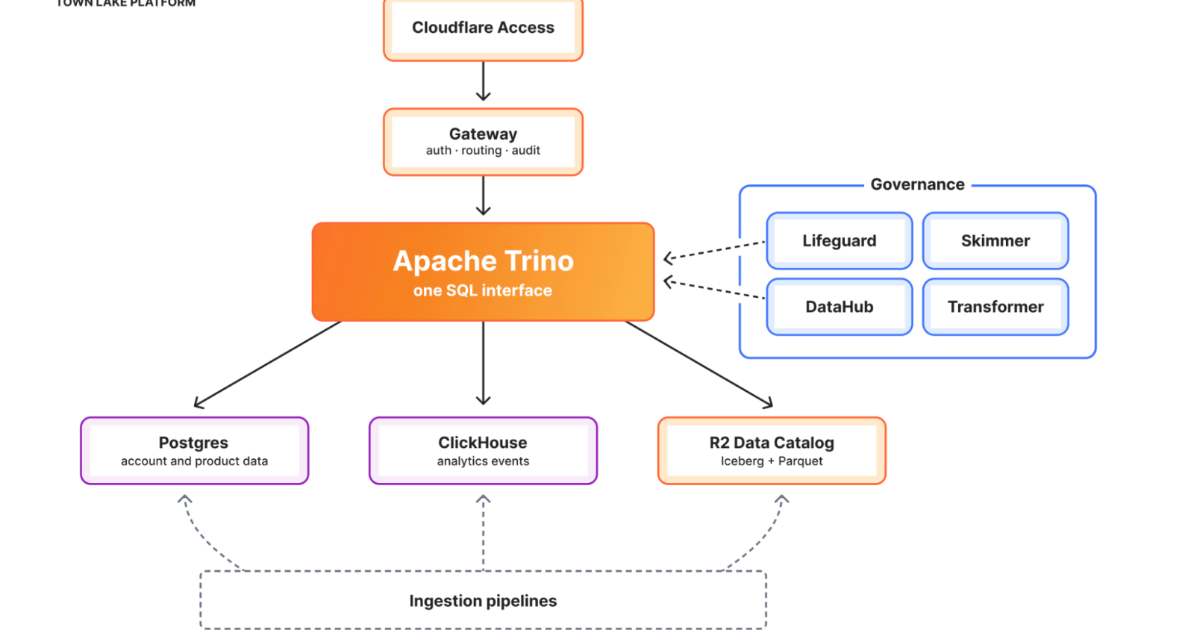
Cloudflare details Town Lake, an internal unified data platform, and Skipper, an AI analytics agent unifying access to operational, billing, security, and business data. The platform processed ~91K billing queries, with billing forming majority usage. Built on a lakehouse architecture using Trino, Iceberg, R2, and DataHub, it enables governed cross-system analytics and natural language access.
By Leela KumiliHardwood Promises High-Speed JVM Apache Parquet Processing with Zero Mandatory Dependencies

Hardwood, the project Gunnar Morling kick-started to improve the handling of Parquet files in Java, reached version 1. Its multi-threaded approach and zero mandatory external dependencies promise a simpler, optimal alternative to the Apache Parquet Java implementation. For now, the library provides a reading via API and a CLI for visualisation; writing support is expected in the upcoming versions.
By Olimpiu Pop
© 2026 Created by Michael Levin.
Powered by

