Codetown
Codetown ::: a software developer's community
Using rs-232 in a java desktop application
Hello all:
I am fairly new to the Java world and would like some advice on how to handle rs-232 communications with a Java based GUI I am working on. Several years ago I created a similar GUI with Visual Basic, but my coding skills are a bit rusty and I never got the communication thing completely figured out. I could send command strings easy enough, but I had trouble getting responses and processing them quickly.
The current GUI is to control an RGB lighting system. It has some sliders, some radio buttons, and a few check boxes. When the sliders move a command string needs to be sent out. It will have to happen quickly so that the change in light level is smooth. When the radio buttons and check boxes are clicked, single commands will have to be sent out.
I would also like to be able to handle any responses sent back from the controller. When the sliders are moved, there will be a lot of comm traffic coming back to the GUI. I sure this will require a buffer of some kind, but I am not sure how to set it up.
Once I get the rs-232 option up and running, I need to look at communicating with the light controller via an Ethernet connection.
Any advise or assistance would be appreciated.
Paul Stearns
Views: 517
Replies to This Discussion
-
Permalink Reply by Paul Stearns on
-
Thanks Nem. I will check those out.
Paul
-
-
I took a look at some of the documentation and it seems that RS-232 is not supported for Windows apps anymore. If this is indeed the case, then I guess I need to look at sending communications via Ethernet and using a converter to get it to the RS-232 device.
Any guidance on how to proceed would be appreciated.
Happy 10th year, JCertif!
Notes
Welcome to Codetown!
 Codetown is a social network. It's got blogs, forums, groups, personal pages and more! You might think of Codetown as a funky camper van with lots of compartments for your stuff and a great multimedia system, too! Best of all, Codetown has room for all of your friends.
Created by Michael Levin Dec 18, 2008 at 6:56pm. Last updated by Michael Levin May 4, 2018.
Looking for Jobs or Staff?
Check out the Codetown Jobs group.
InfoQ Reading List
Android Studio Narwhal Extends Gemini AI Capabilities

The latest Android Studio Narwhal 3 Feature Drop introduces enhancements aimed at boosting developer productivity, including support for resizable Compose previews, new app Backup & Restore tools, and expanded Gemini capabilities such as automatic code generation from UI screenshots.
By Sergio De SimoneResearcher Unearths Thousands of Leaked Secrets in GitHub’s “Oops Commits”

Security researcher Sharon Brizinov, in collaboration with Truffle Security, has conducted a sweeping investigation of GitHub's "oops commits", force-pushed or deleted commits that remain archived, and uncovered thousands of secrets left behind, including high-value tokens and admin-level credentials
By Craig RisiHow Sociotechnical Design Can Improve Architectural Decisions

Sociotechnical design in software development emphasizes creating systems where people and technology thrive by fostering collaboration, emergent coherence, and shared understanding through enabling constraints, leading not only to improved architecture but also to more effective, adaptive, and fulfilling work.
By Ben LindersPresentation: Multidimensionality: Using Spatial Intelligence x Spatial Computing to Create New Worlds

Erin Pañgilinan discusses the future of frontend and backend engineering, where XR and AI converge. She explains how the XR tech stack is evolving with foundation models and AI agents, enabling new use cases in spatial intelligence, code generation, and automation. She shares insights on the shift toward accessible, low-code tools.
By Erin PañgilinanPresentation: Architecture in the Lead: Scaling Today, Shaping Tomorrow
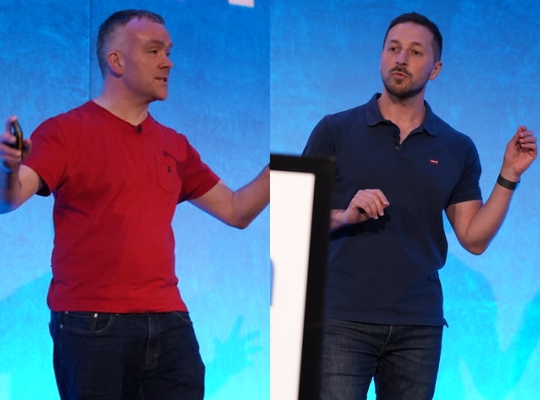
Ian Arundale and Matthew Clark discuss the BBC's architecture for handling massive digital moments like general elections. They explain how a serverless-first approach and a focus on three key non-functional requirements - elasticity, resilience, and security - enabled them to build a highly scalable platform. They also share how architects' soft skills are crucial for implementation.
By Matthew Clark, Ian Arundale
© 2025 Created by Michael Levin.
Powered by

