Codetown
Codetown ::: a software developer's community
OrlandoJUG on Maven Jan, '10
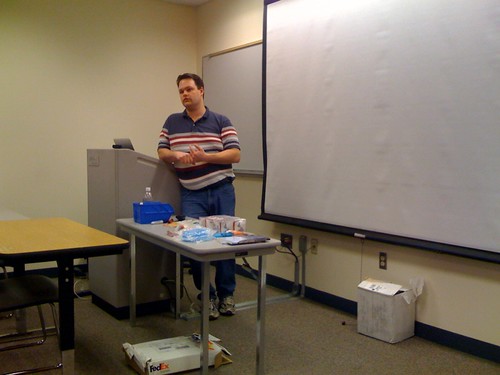
Brian Fox gave a presentation on Maven this month at the OrlandoJUG.
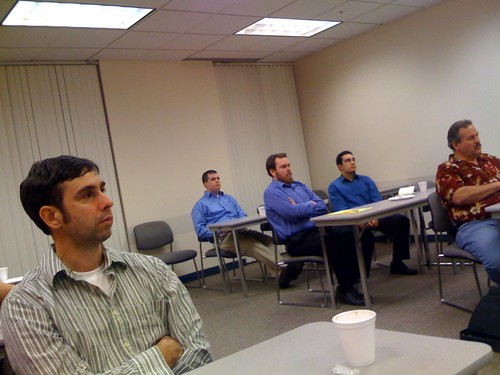
Maven has matured into a more user friendly tool, according to Brian. His company, Sonatype, supports Maven in the commercial world. They've published books as well.
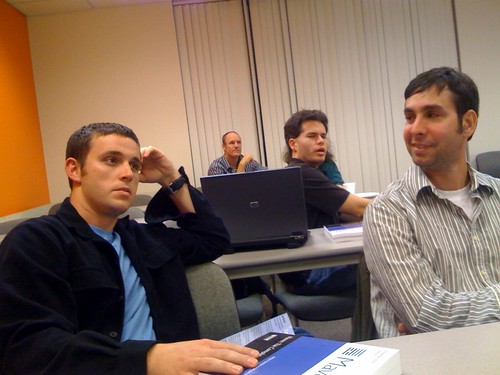
I must admit, although the talk was informative, I didn't walk away feeling like I could sit down and start using Maven based on what I learned. This was an overview of Maven's features, not a hands on workshop.
I will say, however, that Maven has wide acceptance as a powerful, open source tool to help in building projects that use multiple components. Last time I used it, I had a very difficult time getting it configured. It just wasn't user friendly. I've learned over the years now that it's often not me, but fragile tools and documentation that cause failures under time contraints.
Yucch!
Well, now we have a set of books on Maven and Sonatype's support to help us along.
I'm ready to give it another shot when the occasion arises.
After the meeting, we chatted about cellphones. David Harris showed us his new Android phone. A spirited conversation ensued. A few people have commented that Java folk should show more discernment in their choice of cellphone, namely iPhones. We talked about iPhone being a closed box. How Apple does everything many folks hate about Microsoft but is forgiven because...because they have "good products". Provocative? You bet. That assertion was countered with a comment that "there's nothing wrong with making money" referring to the two camps that sometimes don't see eye to eye: open source and commercial apps.
We had some good pizza, cold drinks and stimulating conversation. Like the sound of it? Come on out to next month's OrlandoJUG, or GatorJUG...or your local user group meeting. We had folks from local software firms I had never heard of, who have been in town as long as I have. What's cool about that? Well, it's not just a hobby! We like work. Work is good. The trick is to find 1) work that's 2) interesting and 3) pays a fair wage. Who ya gonna call? I prefer to throw the party rather than wait around to be invited. You, too can be the master of your own destiny. Get up, get out and meet some folks. Share what you know and learn some stuff while filling your belly with good food and have a good time!
Comment
-
Comment by Zemian Deng on January 31, 2010 at 1:13pm
-
Hey Mike,
Sorry to hear you are not a fan of Maven yet. Well, I don't think you are the only one. This link got mentioned in javaposses.com last broadcast. http://kent.spillner.org/blog/work/2009/11/14/java-build-tools.html. Doesn't sound like that guy like Maven at all. :-P
There few things in Maven that bugs me too. Like its verboseness in xml config, the many defaults values in for frequently used plugins are outdated. Like compiler target source is not default to 1.5 or higher, default java source is not UTF-8, default junit comes with a useless xml out of system defaults. I have to change these on most of my project since they seems not up-to-date. But these seems to be minor things. It's configurable and I just change the values and move on.
Having said that, I think Maven is a wonderful tool. Like any piece of software, we ought to use it as it was designed to take a full advantage of it. I have used for many projects and it solved most of my need as a build tool. Sonatype's repository manager is pretty awesome. It has a simple user interface and easy to manage. It's fantastic to setup as a internal repository in a company.
To gain more confidence, you should check out how few of larger open source projects are using Maven. Obviously Apache is using maven like crazy :-P. But hey Apache produce some great some software, and maven helps them get there. Check out JBoss, originally use Ant for everything, and now they switched to entirely Maven based build starting jboss6. MuleESB and Atlassin JIRA are couple of my favorite and successfully software that I know they use Maven heavily for their dev.
Happy 10th year, JCertif!
Notes
Welcome to Codetown!
 Codetown is a social network. It's got blogs, forums, groups, personal pages and more! You might think of Codetown as a funky camper van with lots of compartments for your stuff and a great multimedia system, too! Best of all, Codetown has room for all of your friends.
Created by Michael Levin Dec 18, 2008 at 6:56pm. Last updated by Michael Levin May 4, 2018.
Looking for Jobs or Staff?
Check out the Codetown Jobs group.
InfoQ Reading List
AWS Introduces Amazon S3 Annotations

AWS recently announced Amazon S3 Annotations, a feature that lets teams attach rich, searchable context such as summaries, classifications, compliance data, or AI-generated insights directly to S3 objects. Annotations can be updated independently of the object and queried across datasets, reducing the need for separate metadata systems.
By Renato LosioClaude Reaches GA on Microsoft Foundry: European Enterprises Cannot Deploy It

Claude models reached GA on Microsoft Foundry with Azure-native billing and governance, but no European data zone exists. Anthropic's own documentation confirms data residency guarantees apply to Bedrock and Vertex AI but not Foundry. European practitioners from banking and healthcare report the offering is unapproved for production.
By Steef-Jan WiggersCycle Introduces EU Control Plane as Sovereignty Debate Continues

Cycle recently introduced a separate EU-based control plane, allowing European customers to keep platform management data and telemetry within Europe. The new offering is designed to improve compliance, operational isolation, and responsiveness for European organizations.
By Renato LosioCloudflare Details Unified Data Platform Where Billing Workloads Account for 53% of Queries
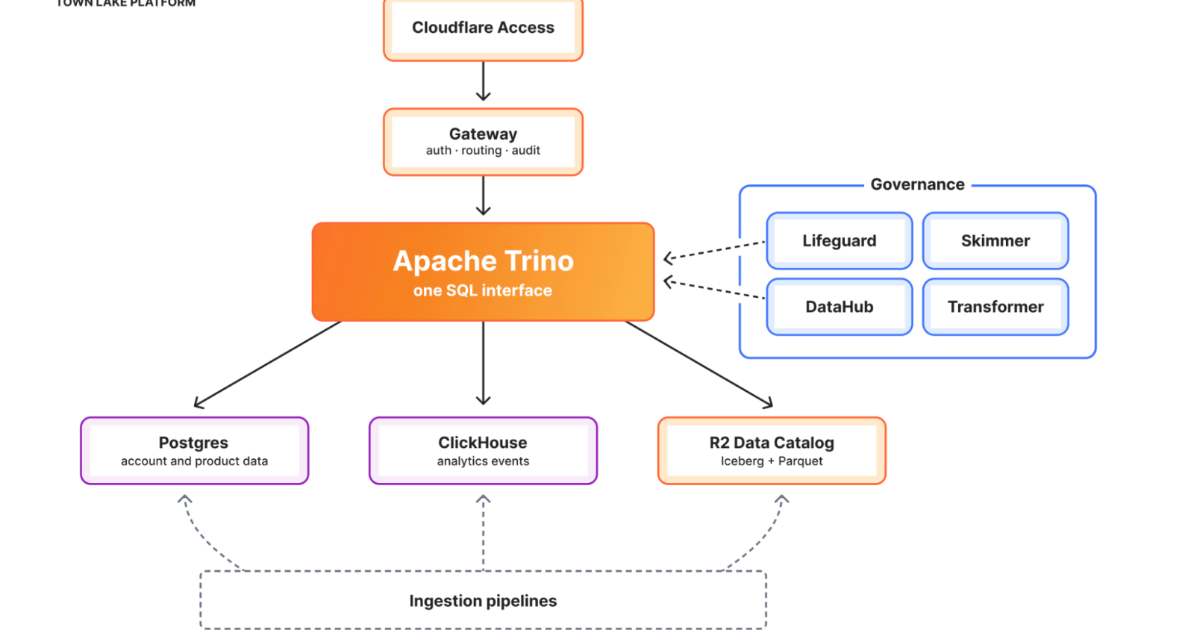
Cloudflare details Town Lake, an internal unified data platform, and Skipper, an AI analytics agent unifying access to operational, billing, security, and business data. The platform processed ~91K billing queries, with billing forming majority usage. Built on a lakehouse architecture using Trino, Iceberg, R2, and DataHub, it enables governed cross-system analytics and natural language access.
By Leela KumiliHardwood Promises High-Speed JVM Apache Parquet Processing with Zero Mandatory Dependencies

Hardwood, the project Gunnar Morling kick-started to improve the handling of Parquet files in Java, reached version 1. Its multi-threaded approach and zero mandatory external dependencies promise a simpler, optimal alternative to the Apache Parquet Java implementation. For now, the library provides a reading via API and a CLI for visualisation; writing support is expected in the upcoming versions.
By Olimpiu Pop
© 2026 Created by Michael Levin.
Powered by


You need to be a member of Codetown to add comments!
Join Codetown